Category Archives: Review

Review: White Flight: Atlanta and The Making of Modern Conservatism

By 1970, the north Atlanta suburban counties of Gwinnett, Cobb, and north Fulton had experienced massive explosions in both population and median income. Their racial profiles were also 95, 96, and 99 percent white, respectively (245). In White Flight: Atlanta and the Making of Modern Conservatism, Kevin Kruse explores the processes leading up to this shift. Kruse sets his study within Atlanta’s urban landscape during the 1950s and 1960s and traces the gradual abandonment of spaces by white citizens and its political impact on the development of the conservative movement. By charting three distinct stages of the movement, Kruse reveals a gradual reorientation in political patterns of white resistance, as white Atlantans moved towards a coded ideological emphasis on individual rights, privatization, and small government. Kruse argues that this combination of physical relocation and political consolidation proved to be the most successful strategy employed by those resisting the civil rights movement.
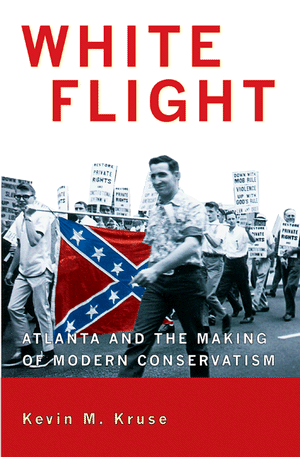
By the late 1940s and early 1950s, working-class whites felt themselves under siege from what they saw as a black invasion of their neighborhoods and public spaces such as parks and swimming pools. Working-class whites at first turned to organized violence and intimidation, but soon realized the importance of winning the battle for public image. In Kruse’s words, “In time, they would learn to put aside the brown shirts of the [white supremacist] Columbians and the white sheets of the Klan and instead present themselves as simple homeowners and concerned citizens.” (44) On an ideological level, they moved from trying to protect the integrity of their communities (a cohesion that Kruse convincingly undermines), and instead began to emphasize their individual rights and liberties to live amongst whomever they chose. In many neighborhoods, their struggle was not enough, as the first wave of black homeowners caused a stampede of white individuals rushing to sell their homes before property values decreased.

Meanwhile, a similar battle over the desegregation of public schools led middle-class whites into the fray during the 1950s. Segregationist leaders quickly picked up on a central theme that ran through their movement (and one that runs through White Flight as well): “freedom of association.” For a middle-class white father, barring blacks from attending the same school as his daughter was purportedly less about denying black people rights as it was preserving his own right to determine who his daughter could and should interact with. Even as this line of reasoning proved ineffectual at halting desegregation, white families fled from public schools into private ones, creating a second-wave of de facto segregation in Atlanta’s school system.

The third stage of white flight came in the early 1960s. As working and middle-class whites faced the integration of their neighborhoods, parks, and schools, many upper-class whites observed the conflict form a distance, safely ensconced in their wealthy neighborhoods, country clubs, and private schools. But with the passage of the Civil Rights Act, suddenly their businesses came under direct assault. Elite businessman, hitherto allied in a moderate coalition with white politicians and black leaders, bitterly struggled against organized sit-in protests and later government injunctions that aimed to desegregate their restaurants and department stores. It was during their struggle that the earlier shifts towards individual rights and privatization crystallized into an organized and increasingly powerful conservative ideology.

The strength of Kruse’s argument lies in tracing this conservative political crystallization, sometimes at the expense of a more rigorous analysis of white flight as a spatial phenomenon. While maps are scattered throughout White Flight, most of them serve as modest visual signposts, when they have the potential to more deeply enrich the project. Nevertheless, Kruse persuasively argues that this tandem of political and spatial movements had profound historical implications. As white Americans increasingly coalesced into white suburban (and later exurban) enclaves, they eventually became the backbone of the Republican party. This “politics of suburban secession,” maintained the traditional tenets of white flight: retreating from any and all interaction with the black community (now synonymous the city itself) and championing minimal government, headlong privatization, and the primacy of the individual.

Kruse is an adept narrator, weaving together a host of characters and events into a compelling storyline of the racial landscape of Atlanta during the mid-20th century. He paints a convincing portrait of a coalescing conservative movement based on withdrawal and charts the distinctive class divisions within this movement. The reader is sometimes left wishing for the kind of broader analysis that mainly occupies the final chapter and epilogue of his book. Atlanta’s patterns of white flight were simultaneously taking place in spaces across the country, yet Kruse offers only passing glimpses of how the city fit within a national framework. Despite this, White Flight remains a compelling case study on the origins of the modern conservative movement within the social and political backlash against the civil rights movement.


Kevin M. Kruse, White Flight: Atlanta and the Making of Modern Conservatism (Princeton University Press, 2005).
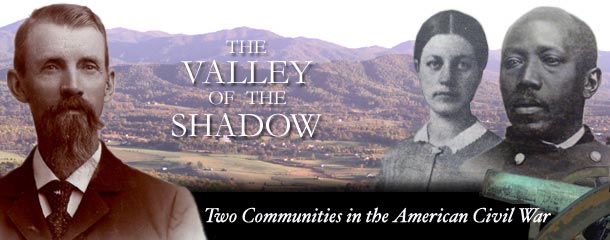
Valley of the Shadow and the Digital Database

Since its inception as a website in the early 1990s, the digital history project Valley of the Shadow has received awards from the American Historical Association, been profiled in Wired Magazine, and termed a “milestone in American historiography” in Reviews in American History. The project is also widely regarded as one of the principal pioneers within the rough-and-tumble wilderness of early digital history.1 Conceived at the University of Virginia as the brainchild of Edward Ayers (historian of the American South and now president of University of Richmond), the project examines two communities, one Northern and one Southern, in the Shenandoah Valley during the American Civil War. The initiative documented and digitized thousands upon thousands of primary source materials from Franklin County, Pennsylvania and Augusta County, Virginia, including letters, diaries, newspapers, speeches, census and government records, maps, images, and church records.

By any measure, Valley of the Shadow has been a phenomenal success. Over the course of a decade and a half, it has provided the catalyst for a host of books, essays, CD-ROM’s, teaching aids, and articles – not to mention more than a few careers. At times it seems that everyone and their mother in the digital history world has some kind of connection to Valley of the Shadow. The impact the project has had, both within and outside of the academy, is a bit overwhelming. In this light, I decided to revisit Valley of the Shadow with a more critical lens and examine how it has held up over the years.

At the bottom of the Valley‘s portal, it reads “Copyright 1993-2007.” There aren’t many academic sites that can claim that kind of longevity, but this also carries a price. In short, the website already feels a bit dated. The structure of the website is linear, vertical, and tree-like. The parent portal opens up into a choice between three separated sections: The Eve of War (Fall 1859 – Spring 1861), The War Years (Spring 1861 – Spring 1865), and The Aftermath (Spring 1865 – Spring 1870). Each of these are divided into different repositories of source material, from church records to tax and census data to battle maps. Clicking on a repository leads to different links (for instance, two links leading to the two counties’ letters). A few more clicks can lead to, say, a letter from Benjamin Franklin Cochran to his mother in which he leads off with the delicious detail of lived experience that historians love: “I am now writing on a bucket turned wrong side up.”

In this sense, the database is geared towards a vertical experience, in which users “drill down” (largely through hyperlinks) to reach a fine-grained level of detail: Portal -> Time Period -> Source Material Type -> County -> Letter. What this approach lacks is the kind of flexible, horizontal experience that has become a hallmark of today’s online user experience. If one wanted to jump from Cochran’s letter to see, for instance, battle maps of the skirmishes he was referencing or if local newspapers described any of the events he wrote about, the process is disjointed, requiring the user to “drill up” to the appropriate level and then “drill down” again to find battle maps or newspapers. This emphasis on verticality is largely due to the partitioned nature of the website, divided as it is into so many boxed categories. This makes finding a specific source a bit easier, but restricts the exploratory ability of a user to cross boundaries between the sites’ different eras, geography, and source types.

If different sections of the website are partitioned from one another, what kind of options exist for opening the database itself beyond the websites own walls? In October of 2009, NiCHE held a conference on Application Programming Interfaces (APIs) for the Digital Humanities, with the problem it was tackling outlined as follows:

To date, however, most of these resources have been developed with human-friendly web interfaces. This makes it easy for individual researchers to access material from one site at a time, while hindering the kind of machine-to-machine exchange that is required for record linkage across repositories, text and data mining initiatives, geospatial analysis, advanced visualization, or social computing.

This description highlights the major weakness of Valley of the Shadow: its (relative) lack of interactiveness and interoperability. A human researcher can access specific information from the website, but it remains a major challenge to employ more advanced digital research techniques on that information. Every database is inherently incomplete. But one way to mitigate this problem is to open up the contents of a database beyond the confines of the database itself. The following scenario might fall under the “pipe-dream” category, but it illustrates the potential for an online database: a researcher writes a programming script to pull out every letter in Valley of the Shadow written by John Taggart, search both the Valley‘s database and national census records in order to identify the letters’s recipients, capture each household’s location and income level, and use that data to plot Taggart’s social world on a geo-referenced historical map or in a noded social network visualization. Again, this might be a pipe-dream, but it does highlight the possibilities for opening up Valley of the Shadow‘s phenomenally rich historical content into a more interactive and interoperable database.

At the end of the day, Valley of the Shadow deserves every ounce of acclaim it has received. Beyond making a staggering array of primary sources available and accessible to researchers, educators, and students, it helped pave the way for the current generation of digital humanists. Valley of the Shadow embodies many of the tenets of this kind of scholarship: multi-modal, innovative, and most importantly, collaborative. Its longevity and success speaks to the potential of digital history projects, and should continue to serve as a resource and model moving forward.


1 I, for one, imagine the early days of digital history to be a rough-and-tumble wilderness, resplendent with modem-wrangling Mosaic cowboys and Usenet bandits.

Review: What Hath God Wraught

Andrew Jackson = bad.

Whigs = good.whathathgodwrought

That’s my five-word summary of Daniel Walker Howe’s Pulitzer-Prize winning, 900-page, career-defining work What Hath God Wrought: The Transformation of America, 1815-1848. Of course, the tome is monumental in every sense of the word, in its subject matter, scope, weight, and approach. Howe is fearless in shouldering the daunting task to chart the the United States’ tumultuous adolescence. In an academic climate of sometimes numbing specialization, What Hath God Wrought is boldly and refreshingly big.

Howe approaches this task by looking at the nation’s growth through the eyes of the two ideological competitors fighting for its future. In one corner sat the Democrat ideals of Andrew Jackson, which lay out a path of white male individualism, territorial and racial conquest, and limited federal government. In the other corner sat the Whig’s ideology of national improvement through an active government and strong internal commercial expansion. Howe maintains this general dichotomy as he wanders down thirty-odd years of national history. The thematic path he treads most commonly is that of the communications and transportation revolution, although he winds enthusiastically down every manner of side trail and parallel road.

Daniel Walker Howe detests Andrew Jackson. His characterization of our seventh president throws all notions of bland academic sterility to the winds, instead engaging in fierce and almost-personal skirmishes against Jackson. First and foremost, Howe argues that Jackson’s legacy is marked by the insidious morally debilitating advancement of white male supremacy.  “…historians have variously pointed to free enterprise, manhood suffrage, the labor movement, and resistance to the market economy. But in its origins, Jacksonian Democracy…was not primarily about any of these, though it came to intersect with all of them in due course. In the first place it was about the extension of white supremacy across the North American continent.”

Howe is absolutely relentless in his campaign against Jackson’s apologists, and in many ways he makes a convincing argument. Indian Removal remains one of the most shameful aspects of our nation’s history, and Andrew Jackson was one of its most effective champions. In the eloquent and caustic words of Howe, “During the Removal process the president personally intervened frequently, always on behalf of haste, sometimes on behalf of economy, but never on behalf of humanity, honesty, or careful planning.” In doing so, Jackson became the figurehead for a growing ideology of American imperialism, as our national borders expanded both literally and figuratively. Howe argues convincingly that the Jacksonian flavor of imperialism included not only territorial expansion, but a dissolution of the rule of law. Concepts such as treaties, property rights, or basic civil liberties were swept aside when it came to the forcible and violent relocation of Indian tribes from their land.

Jackson also gets taken to task for his assault on that pesky thorn in the side of ideologues everywhere: freedom of speech. Specifically, Jackson attempted to stifle the increasingly loud voices of abolitionists, whom he deemed “monsters.” He took action by using federal control of the postal system to hinder abolitionist material from being transported through the mail. Jackson also went further, instructing his postmaster general to publish the names of abolitionists guilty of “exciting the negroes to insurrection and to massacre.” These measures were met with mixed results, but regardless, Howe fulminates that restricting abolitionist material through the post quite possibly constituted “the largest peacetime violation of civil liberty in U.S. history.” Umm, Mr. Howe? Didn’t you just describe the violent removal of tens of thousands of people from their rightfully-owned property? Might that not constitute a bigger “peacetime violation of civil liberty”?

Big, bold statements such as these make What Hath God Wrought fun and refreshing, but Howe’s argumentation can sometimes stray into the realm of hyperbole. I appreciate the fact that he makes no bones about having an overt historiographical agenda, but it can lead to rather blatant side-taking. For instance, in Howe’s view, Jackson’s administration had a hand in causing the Panic of 1837: “Democrats blamed the banks. Whigs blamed Jackson.” Which side do you think Howe falls on? Thankfully, he doesn’t play coy: “There is more truth in the Whig argument.” Meanwhile, Howe spends ample time cheerleading the expansion of federally-funded internal improvements under John Quincy Adams (a Whig), but when that same federal funding for internal improvement soars even higher under Jackson, Howe dismisses the administration’s efforts as hypocritical, ad-hoc, and ambiguous.

In comparison to Jackson, Howe takes a decidedly rose-tinted view of the Whigs. Given his scholarly background as the author of The Political Culture of the American Whigs, this isn’t necessarily surprising. In Howe’s opinion, “the Whigs, though not the dominant party of their own time, were the party of America’s future.” He (rightfully) champions their role in connecting a disparate young collection of states and communities into an integrated whole. Howe even opens the “what-if” door to offer a brief glimpse into what might have been different had John Quincy Adams won the 1828 election instead of Andrew Jackson. Although he doesn’t come out and say it, Howe delicately insinuates that maybe, just maybe, an Adams administration could have pre-emptively prevented the Civil War: “[The Whigs'] strong central government would have held long-term potential for helping the peaceful resolution of the slavery problem…” I mean, come on…really? For that small segment of the American population interested in historiography (like myself), nuggets such as these contribute to the juicy platter of provocative scholarly interpretation that Howe serves up to his readers.

Howe’s romp through the historical period is done with a stylistic flair and easy grace that continously impressed me. In the hands of many writers, a three-decade survey of America would devolve into a yawn-inducing litany of dates, names, and events. Instead, Howe nimbly leaps from micro to macro across a dizzying geography, effortlessly mixing anecdotes, analysis, and arguments. His writing is evocative and unpretentious, allowing him to open a paragraph bluntly: “Then the whole thing blew up in the administration’s face,” and to end a chapter with a playful cliffhanger: “Why an abolitionist believed Texas annexation presented a moral crisis requires explanation.” The skill with which he crafts language allows him to show off his stunning grasp of the subject matter – a fantastic combination that contributes to his humble (tongue-in-cheek?) claim that “This book tells a story” – and, I might add, one told by a supremely skilled storyteller.

Review: The Postal Age

The hardcover version of David Henkin’s The Postal Age: The Emergence of Modern Communications in Nineteenth-Century America catches your eye immediately, as a tall and slim volume that looks not unlike a slightly oversized envelope from another century. Likely by design, the physical layout of the book certainly primes the reader for it contents. As an examination of the rise of the American postal system in the middle decades of the 19th century (roughly the 1840’s-1860’s), The Postal Age offers up a fascinating blend of intellectual, cultural, and thematic history.

Henkin lays out his book in two sections. “Joining a Network” focuses on a more nuts-and-bolts examination of the spread of the postal system, how and what people mailed, and mail in a rising urban environment. The second section, “Postal Intimacy,” takes a more cultural approach towards common letter-writing styles and cliches, the post as a lens for growing geographic mobility, and the rise of mass mailings.

As someone who often struggles with writing introductions, I was absolutely blown away at how Henkin handled his own introduction. He used the story of Anthony Burns, a captured fugitive slave who somehow managed to write several letters from his jail cell in Virginia in 1854: “[Burns] managed to use the facilities of the federal postal system, including those housed in Virginia, to engage in confidential correspondence with his abolitionist lawyer in Boston.” Of course, Henkin used the Burns anecdote as a particularly powerful springboard to launch into the introduction to the meat of his book: the “cultural transformation” over the past decades that made the story possible. If I ever manage to write such a clever introduction, I’d consider myself satisfied.

I also particularly enjoyed his second chapter, “Mailable Matters,” which discussed what people mailed and how it evolved during his timeframe of study. In particular, the history of “transient newspapers,” (periodicals sent along through the post by someone other than the publisher) was fascinating. People used newspapers to anchor the recipient in a far-off place, provide information, and even work as a covert means of relaying personal messages. Due to its lower cost compared to letters, senders would mail newspapers with “‘Cabalistic concealment,” such as making certain marks or drawing pictures in the margins in order to convey basic information.

The postal bureaucracy of course cracked down on this practice, and by 1845 Congress had passed a postal price reduction that lowered the price of letters and reduced the appeal of transient newspapers. Interestingly, Henkin chooses to glide through much of the political legislation or campaigns behind critical postal reforms (such as the 1845 reduction). At times I wanted more background beyond the passing references to political history that Henkin often uses as distant backdrop for the center stage of cultural inquiry. Who spearheaded these campaigns? Was there a regional divide in lobbying efforts (coastal states vs. frontier regions)? Economic divides (merchant vs. agrarian classes)? I’m not sure if a lengthier discussion of these issues would have bogged down the writing pace, but at times it might have been helpful.

Henkin also discusses the growing transitory movements during the middle of the century, and in particular how letters and familial correspondence played a role in morally anchoring migrant men during the Gold Rush and the Civil War. Surrounded by the debauchery of mining or army camps, personal letters from wives, sisters, and mothers became mythologized as virtual placeholders of domesticity and moral influence. In fact, contemporaries often referred to letters from home in near-religious terms, whose effects on otherwise rough and tumble forty-niners “eerily resembles a conversion experience.” Even men who had spent the previous night gambling, drinking, and carousing with prostitutes could open a letter from his far-away home and be swept up in a fit of repentance and (presumed) absolution.

Finally, the last chapter I found to be the most fascinating: “Mass Mailings: Valentines, Junk Mail, and Dead Letters.” The information presented by Henkin took me by surprise, as I had no idea the sheer scale and reach of such mass mailings. For instance, the rise of the postal system went hand-in-hand with the rise of Valentine’s Day, as a new culture of exchange grew up surrounding the day (including cruel/hilarious V-Day pranks and mock valentines). Meanwhile, I loved Henkin’s discussion of the phenomenon of “dead letters,” those pieces of post that never reached their intended recipient (due to faulty address-writing, not being picked up at the post office, etc.) These letters would sit for three months in local post offices before being sent to the Dead Letter Office in Washington, D.C. – in 1866 alone, almost 5.2 million letters ended up at this office.

Henkin wryly notes that these letters “were not quite dead, but they were certainly in critical condition.” Dead letters fascinated an American populace, and for good reason: their contents offered an incredibly intimate, almost voyeuristic, glimpse into the lives of everyday Americans. The list of items that were lost in the mail is a staggering array of oddities, including sewing machines, rattlesnake skin, and of course money of all denominations. Dead letters also revealed the inherent tension that accompanied the rapidly-expanding social worlds of everyday Americans. A letter addressed “To the big-faced Butcher, with a big wart on his nose – Cleveland, Ohio” may have worked for close-knit communities, but by the middle of the century these familiar addresses proved inadequate to meet the requirements of a national postal network. In a beautifully crafted piece of writing, Henkin writes, “Dead letters floated in the intermediate space between names and people, and between the personal recognition marked by an individually addressed letter and the impresonality of a large, mobile, and uprooted society.”

David Henkin writes engagingly, without relying on a traditional narrative format to tell his story. The volume is, to use a cliche of reviewers, exhaustively researched. The pages are teeming with specific examples and tidbits of primary research, yet it does not get bogged down by offering up footnoted research notes for their own sake. Henkin utilizes the full toolkit of the cultural and intellectual historian in order to craft a unique perspective on the growth-filled adolescent years of American history.

Review: National Museum of American History

(Cross-posted at Progressive Historians)

On a cold Friday morning this past November, I set my alarm extra early, walked to the metro, and made my way to the ribbon-cutting ceremony for re-opening of the Smithsonian’s National Museum of American History. After staking out a position in the crowd next to the television crews, I was rewarded for a forty minute wait by turning around and coming face-to-face with Colin Powell, who was making his way to the stage flanked by security.  I was too star-struck to say anything besides, “Good morning, sir,” although I did get to shake his hand on his way out. After a relatively short ceremony that included the national anthem and Powell reading the Gettysburg Address, they cut the ribbon and let the streaming crowds into the renovated and revamped museum. I took a brief walk around before realizing I was late for work. Today I finally had the chance to return to the museum for a proper exploration.

I had never been to the pre-renovation museum, but from what I’ve read it was relatively dark and cluttered. The new museum has largely addressed these issues, as the main lobby on the mall entrance is expansive, and wide glass skylights allow in ample sunlight to illuminate sleek architectural lines. Guests are funneled largely towards the crown jewel of renovation efforts: a multi-million dollar, state-of-the-art exhibit to house and display the Star-Spangled Banner. I was less than impressed with the exhibit. The visitor is first led down a hallway containing some basic background behind the story of the flag. The information was not conveyed very clearly, the lighting was too dim, and the wall screens displayed cheesy and surprisingly low-tech animations of the War of 1812. The part of the exhibit displaying the flag itself was a bit better, and it gave a very strong sense for the sheer size and weight of the flag (30 x 34 ft):

Next to the flag was a really well-done tabletop with a slowly scrolling and panning zoomed image of the flag, with small nodes/hostpots that the visitor could “click” to open up a infobox on various aspects of the flag. I thought the coolest part was that it gave the impression of a massive touch-screen, but all of it was in fact a projected image from above with an extremely sensitive sensor system that created a supremely dynamic and fluid interactive framework.

The next exhibit I walked through was the impressive “Within These Walls,” which leads the visitor around a partially reconstructed house from the town of Ipswich, Massachusetts:

Originally constructed in the mid-18th century, the house serves as a focal point for exploring its development through the next two centuries. My favorite aspect of the exhibit was an impressive use of written primary source material alongside the flashier material objects. Behind the array of medallions and tables, the walls themselves displayed important texts with pertinent sections highlighted. For example, one panel displayed a recorded will from one of the house’s residents that included a mention of Chance, a black house servant and former slave. This was a conscious decision on the part of the curator(s), as they begin the exhibition with an explanation of how historians find “clues” to examine the house. The exhibit does a great job of weaving together these clues, from allowing visitors to view a sample paint chip through a microscope to see its different layers, to enhancing an old map of the neighborhood with overlaid photographs and diagrams of a nearby mill and train depot. While a little bit simplistic, I was impressed at their efforts to make the process of historical research and discovery more accessible to a general public beyond, “Hey check out this sweet Gatling Gun!”

The next exhibit I explored was “Communities in a Changing Nation,” which uses three different communities (New England factory workers, Cincinatti’s Jewish enclave, and blacks in South Carolina) to examine 19th-century America:

In my opinion, “Communities in a Changing Nation” was less than impressive. It embodied a lot of the less appealing elements of a more “traditional” museum exhibit. Using a largely linear approach, with exhibits on either side of the hallway, it lacked both clarity and innovation. The exhibit assigned a matrix system of four broader themes to the three communities: Land and Abundance, Equality and Democracy, Freedom and Independence, and Progress and Opportunity. I didn’t even realize this thematic attempt until halfway through the exhibit, and even when I was aware of these themes, I had trouble identifying differences between them. Finally, the African-American community seemed a little patronizing. It included several life-like mannequins that didn’t work that well, especially considering that none of the other “communities” had similar displays. While not necessarily offensive, I don’t think it was done with particular subtlety or sensitivity.

If anyone has the chance to go to the museum in the next several weeks, I’d recommend seeing the White House copy of the Gettysburg Address, on loan only until January 4th, 2009. While the exhibit itself isn’t anything special, being able to see Lincoln’s handwritten copy of arguably one of the most famous speeches in American history is certainly special in and of itself.

Finally, my surprise favorite exhibit was “America on the Move,” a massive, winding exploration of transportation in America. I was largely skeptical as I entered through a doorway labeled “General Motors Hall of Transportation,” and prepared myself for overt championing of the automaking industry alongside a superficial, traditional, and commercialized presentation. Instead, I was greeted with a remarkably organic layout. Although a bit confusing for those who like linear, clearly organized exhibits, I soon discovered the joys of stumbling onto various nooks and corners and becoming utterly absorbed in individual sections. Public historians talk a lot of about allowing the visitor to explore a space for themselves, but it’s often difficult to achieve this goal. I felt that “America on the Move” managed to accomplish it.

As an example of one such instance of exploration, I inadvertently walked into a side-room that included two screens, one on a pedestal and another wall-sized display mounted above. On the smaller screen, the visitor could place pins onto a touchscreen map of the world, with each pin representing their lineage – where they, their parents, and their grandparents were born. Upon completion, the results were displayed on the larger screen before being added to an aggregate dot-image map displaying the results of every visitor’s participation. The composite image was a constantly-changing and growing database displaying museum visitors’ ancestries. The viewer was left not only with a larger sense of what constituted being “American,” but also a feeling of participation in a larger project.

I was impressed with the immersive aspect of “America on the Move,” largely made possible through the significant donations of a wide range of supporters (including, unsurprisingly, GM, AAA, Exxon Mobil, UPS, and Caterpillar). But there was an attention to detail that made it really fascinating – for instance, displays that included baskets of synthetic fruit to be transported actually smelled like fruit (or something like fruit). When the visitor stepped on board a model commuter bus, its vibrating machinery, moving images, and sharp sounds actually made them fell like a 1959 commuter. There is a fine line between overdone and cheesy special effects and those subtle touches that accomplish the goal of making the visitor feel like they are actually “there.” The exhibit did a great job of deftly navigating that line.

The Smithsonian National Museum of American History is faced with a daunting task: preserving and displaying our entire nation’s history. There is simply no way to adequately accomplish this task, and there will always be omissions and interpretative differences. But if the museum makes a real commitment to gather and respond to feedback from a variety of sources, to evolve and ask tough questions, and to continually self-improve beyond a $85 million physical renovation, then I am optimistic for its future as a publicly accessible gateway into examining America’s past.

Review: A Midwife’s Tale

Laurel Ulrich’s A Midwife’s Tale was published in 1990, and achieved what sports coaches would call a complete victory. Its accolades included a Bancroft and a Pulitzer, along with the AHA’s Joan Kelly and John H. Dunning prizes. Favorable academic reviews were balanced with smashing commercial success, and the book remains a top-selling and widely recognized title.

I finished reading the book last month, and was quite impressed. Ulrich lays out the book into chronological chapters, each of which focus on a particular series of events in the life of Martha Ballard, a midwife who practiced in Hallowell, Maine. After printing several excerpts from the diary on which the book was based at the beginning of each chapter, Ulrich delves into analysis and discussion of the events, their context, and their meaning. Topics range from marital infidelity, the spread of rural debt, evolving (or devolving) medical practices, and the neighbor economy. Ulrich treats each of these subjects with a remarkably incisive and thorough exploration of how oftentimes sparse and measured words in a diary can open up windows into the world of late eighteenth and early nineteenth century New England.

Ulrich writes beautifully, and offers up a plethora of quotable passages ranging from the sage to the touching to the comedic. Included in this is the methodological advice that, “Opening a diary for the first time is like walking into a room full of strangers. The reader is advised to enjoy the company without trying to remember every name.” Meanwhile, when discussing rural debt, Ulrich writes, “Martha’s diary shifts the focus from mortgages and lawyers to wood boxes and sons, showing how family history shaped patterns of imprisonment in an era of political and social transformation…” This is a wonderful quote, and one that succinctly and powerfully makes the argument for the importance of social and family history.

I would argue that Ulrich has had as much of an impact on the field of US social history as any historian in the past twenty years. Social history has been taken seriously within the academy for years, but it has had a slow journey onto the bestseller bookshelves of Barnes and Noble. However, in Ulrich’s case, a great many people recognize the title of her book, which is a monumental achievement for any historical work, and it is made even more remarkable by the fact that it was published 18 years ago. Popular history books are dominated by the subject areas of “great man” biography, military (particularly Civil War and Revolutionary) history, and to a lesser degree politics and economics. To have achieved this level of commercial success with the general public while writing about a relatively obscure eighteenth-century rural woman is a remarkable achievement. Ulrich’s ultimate success was combining the scholarly and commercial potential for a work of social history, demonstrating that the bottom-up perspective can be told with equal degrees of academic thoroughness and popular appeal.

I enjoyed the book on a personal level for a variety of reasons. It dealt with much of the same subject matter as my thesis (social history, rural and neighbor economic patterns, etc.), and she used an empirical methodology that deeply appeals to me. While browsing online, I came across a great interview with Ulrich that spells out how she did much of her research. She took an incredibly disciplined and thorough approach to cataloging almost every aspect of the diary:

I began by counting things. The very thing that had attracted me to the diary in the first place was also the thing that made it difficult to work with. I mean there’s just so much. The diary is a long accumulation of workaday entries. And so I had to find some way to get control of the information so that I could find patterns in it. I hit upon the idea of making up a little form, kind of a data collection form. (And this was in the days before personal computers). And I would go day by day for every other year of the diary, and I would tick off what was in each entry: baking or brewing, spinning or washing, or trading, sewing, mending, deliveries, general medical accounts, going to church, visitors, people coming for meals, etc. Using these sheets, I was able to count the incidence of virtually every activity mentioned in the diary.

When reading this, I couldn’t help but think what Ulrich could have accomplished if she had been conducting her research twenty years later with even a basic grasp of how to use text mining tools. She ended up only cataloging every other year to (understandably) “keep her sanity,” but writing a relatively simple program would have allowed for a far greater and faster analysis of such a huge collection of data. I’m not sure Ulrich could have purposefully given a better plug for the potential and power of digital history.

It is a testament perhaps to the influence and impact of scholars in social and women’s history (such as Ulrich) that I didn’t find the book to be ground-breaking in its subject matter. In the two decades since writing it, women’s history has shifted from a fringe focus to a widely accepted (albeit not fully mainstream) path. The idea of writing about a small-town midwife does not seem like a revolutionary approach within today’s academic landscape. Instead, I read A Midwife’s Tale for what it was: a phenomenally well-researched and well-written work that took an in-depth and refreshing perspective on life in the early American republic.

Review: Placing History (III)

(This is the third installment of my review of Placing History. See the first and the second parts.)

I’ve finally finished Placing History: How Maps, Spatial Data, and GIS are Changing Historical Scholarship. As my previous posts have made clear, I’m quite impressed with the breadth and depth of the compilation. As before, I’ll briefly recount the remaining chapters, and wrap up my thoughts at the end.

“Mapping Husbandry in Concord: GIS as a Tool for Environmental History,” by Brian Donahue. I liked this chapters for a multitude of reasons. On a personal note, his research is quite similar (though wider in scale) to the work I did in mapping property holdings and transactions of Venture Smith. So in a self-congratulatory mood, I found myself nodding with satisfied agreement at his various points about the benefits and drawbacks to mapping land deeds and parcels. On a less personal level, I liked the various angles he took in pursuing his study of Concord – especially examining seemingly disparate holdings of a variety of original families and noting patterns of land use.

“Combining Space and Time: New Potential for Temporal GIS,” by Michael Goodchild. For starters, the cover illustration for this chapter was a piece of Charles Minard’s famous “Carte Figurative,” which depicts a staggering array of geographic, temporal, and statistical information regarding Napoleon’s ill-fated Russian campaign:

Charles Minard

Charles Minard's "Carte Figurative"

Information graphic guru Edward Tufte described it as “the best statistical graphic ever drawn,” which effectively canonized it for any map and information graphic nerd such as myself. This is a roundabout way of saying I was excited to start reading Goodchild’s chapter. Goodchild doesn’t dissapoint, as he uses decades of geography experience to explore ways in which the field is gradually shifting to incorporate temporal data. Although its heavy on technical geography, it’s a rewarding chapter that covers one of the fundamental challenges of historical GIS: how do you visually display the relationship between space and time? Goodchild predicts that this challenge will rapidly diminish, as tools and systems to display things such as dynamic data, or even a history-specific model, will become more and more accessible and widespread.

“New Windows on the Peutinger Map of the Roman World,” by Richard J.A. Talbert and Tom Elliot. Talbert and Elliott present an analysis of the Peutinger Map, a nearly 7 meter long Roman map depicting the Mediterranean world and beyond, constructed around 300 CE:

Detail of Peutinger's Map

Detail of Peutinger's Map

I liked this chapter a lot, despite my complete unfamiliarity with the subject matter. The authors make compelling arguments backed by GIS analysis, such as: “the basis of the map’s design was not its network of land routes (as has always been assumed) but rather the shorelines and principal rivers and mountain ranges, together with the major settlements marked by pictorial symbols.” They present a quantitative analysis of routes, and utilize a histogram to further examine the segments and their distances.

“History and GIS: Implications for the Discipline,” by David J. Bodenhamer. This chapter, along with the first chapter and conclusion, gives the best “big-picture” perspective on historical GIS. Bodenhamer describes the field of history as a whole, in particular elements of it that relate to spatial analysis. He believes that in order for GIS to become a valuable historical tool, “it must do so within the norms embraced by historians…” GIS is well-situated to do so, because it uses a format of presenting information (the map) that historians are already familiar with, and its visualization and integration of information makes it easier to display the complexity of historical interpretation. He also discusses the challenges to historical GIS. One point I really liked was that technology as a whole, and GIS in particular, often requires a level of precision that historical documents cannot display within “a technology that requires polygons to be closed and points to be fixed by geographical coordinates.” Other challenges range from the theoretical (ex. temporal analysis) to the practical (ex. learning a completely new discipline). Finally, he succinctly sums up one of the greatest challenges: “GIS does not strike many historians as a useful technology because we are not asking questions that allow us to use it profitably.” I could not have said it better myself – until historians begin to ask the type of questions that can be addressed through spatial analysis, GIS will likely remain a technological oddity within the discipline.

“What Could Lee See At Gettysburg?” Anne Kelly Knowles. This is probably one of the most accessible chapters in the book for a layperson. It combines an engaging narrative prose with rich, stylistic maps, and a “popular” subject matter (the Battle of Gettysburg). But more importantly, it clearly presents an answer to a historical question, while contextualizing the issue and presenting possible ideas for future studies. Viewshed (line-of-sight) analysis is of obvious and particular interest to military historians, but it has other implications as well. In particular, this chapter illustrates the phenomenal power of GIS to transport the reader to the past, and get a micro sense of “being” there.

Beyond thoroughly enjoying Placing History, I believe it’s an important contribution to the field of historical methodology in general, and (of course) historical GIS in particular. The compilation gives a wonderful balance while thoroughly exploring the topic: its current state and background, case studies ranging from micro to macro and “hard” to “soft”, discussions on theory and approach, and an outline for the future. I recommend the book to educators, historians, digital humanists, or anyone with even a passing interest in a growing and valuable area of scholarship.