Archive for February 2010
Review: White Flight: Atlanta and The Making of Modern Conservatism
By 1970, the north Atlanta suburban counties of Gwinnett, Cobb, and north Fulton had experienced massive explosions in both population and median income. Their racial profiles were also 95, 96, and 99 percent white, respectively (245). In White Flight: Atlanta and the Making of Modern Conservatism, Kevin Kruse explores the processes leading up to this shift. Kruse sets his study within Atlanta’s urban landscape during the 1950s and 1960s and traces the gradual abandonment of spaces by white citizens and its political impact on the development of the conservative movement. By charting three distinct stages of the movement, Kruse reveals a gradual reorientation in political patterns of white resistance, as white Atlantans moved towards a coded ideological emphasis on individual rights, privatization, and small government. Kruse argues that this combination of physical relocation and political consolidation proved to be the most successful strategy employed by those resisting the civil rights movement.
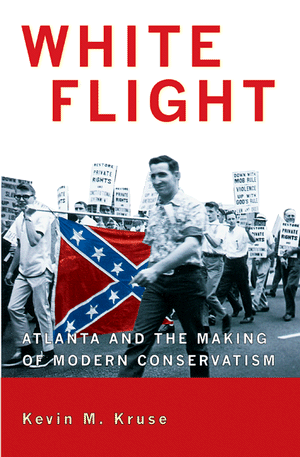
By the late 1940s and early 1950s, working-class whites felt themselves under siege from what they saw as a black invasion of their neighborhoods and public spaces such as parks and swimming pools. Working-class whites at first turned to organized violence and intimidation, but soon realized the importance of winning the battle for public image. In Kruse’s words, “In time, they would learn to put aside the brown shirts of the [white supremacist] Columbians and the white sheets of the Klan and instead present themselves as simple homeowners and concerned citizens.” (44) On an ideological level, they moved from trying to protect the integrity of their communities (a cohesion that Kruse convincingly undermines), and instead began to emphasize their individual rights and liberties to live amongst whomever they chose. In many neighborhoods, their struggle was not enough, as the first wave of black homeowners caused a stampede of white individuals rushing to sell their homes before property values decreased.
Meanwhile, a similar battle over the desegregation of public schools led middle-class whites into the fray during the 1950s. Segregationist leaders quickly picked up on a central theme that ran through their movement (and one that runs through White Flight as well): “freedom of association.” For a middle-class white father, barring blacks from attending the same school as his daughter was purportedly less about denying black people rights as it was preserving his own right to determine who his daughter could and should interact with. Even as this line of reasoning proved ineffectual at halting desegregation, white families fled from public schools into private ones, creating a second-wave of de facto segregation in Atlanta’s school system.
The third stage of white flight came in the early 1960s. As working and middle-class whites faced the integration of their neighborhoods, parks, and schools, many upper-class whites observed the conflict form a distance, safely ensconced in their wealthy neighborhoods, country clubs, and private schools. But with the passage of the Civil Rights Act, suddenly their businesses came under direct assault. Elite businessman, hitherto allied in a moderate coalition with white politicians and black leaders, bitterly struggled against organized sit-in protests and later government injunctions that aimed to desegregate their restaurants and department stores. It was during their struggle that the earlier shifts towards individual rights and privatization crystallized into an organized and increasingly powerful conservative ideology.
The strength of Kruse’s argument lies in tracing this conservative political crystallization, sometimes at the expense of a more rigorous analysis of white flight as a spatial phenomenon. While maps are scattered throughout White Flight, most of them serve as modest visual signposts, when they have the potential to more deeply enrich the project. Nevertheless, Kruse persuasively argues that this tandem of political and spatial movements had profound historical implications. As white Americans increasingly coalesced into white suburban (and later exurban) enclaves, they eventually became the backbone of the Republican party. This “politics of suburban secession,” maintained the traditional tenets of white flight: retreating from any and all interaction with the black community (now synonymous the city itself) and championing minimal government, headlong privatization, and the primacy of the individual.
Kruse is an adept narrator, weaving together a host of characters and events into a compelling storyline of the racial landscape of Atlanta during the mid-20th century. He paints a convincing portrait of a coalescing conservative movement based on withdrawal and charts the distinctive class divisions within this movement. The reader is sometimes left wishing for the kind of broader analysis that mainly occupies the final chapter and epilogue of his book. Atlanta’s patterns of white flight were simultaneously taking place in spaces across the country, yet Kruse offers only passing glimpses of how the city fit within a national framework. Despite this, White Flight remains a compelling case study on the origins of the modern conservative movement within the social and political backlash against the civil rights movement.
Kevin M. Kruse, White Flight: Atlanta and the Making of Modern Conservatism (Princeton University Press, 2005).
Chasing the “Perfect Data” Dragon
Whenever I put on my proselytizing robes to explain the potential of digital humanities to a layperson, I usually point towards the usual data deluge trope. “If you read a book a day for the rest of your life, it would take you 30-something lifetimes to read one million books. Google has already digitized several times that number.” etc. etc. The picture I end up painting is one where the DH community is better-positioned than traditional academics to access, manipulate, and draw out meaning from the growing mountains of digital data. Basically, now that all this information is digitized, we can feed the 1′s and 0′s into a machine and, presto, innovative scholarship.
Of course, my proselytizing is a bit disingenuous. The dirty little secret is that not all data is created equal. And especially within the humanist’s turf, most digitized sources are rarely “machine-ready”. The more projects I work on, the more and more convinced I become that there is one real constant to them: I always spend far more time than I expect preparing, cleaning, and improving my data. Why? Because I can.
A crucial advantage to digital information is that it’s dynamic and malleable. You can clean up a book’s XML tags, or tweak the coordinates of a georectified map, or expand the shorthand abbreviations in a digitized letter. Which is all well and good, but comes with a pricetag. In a way that is fundamentally different from the analog world, perfection is theoretically attainable. And that’s where an addictive element creeps into the picture. When you can see mistakes and know you can fix them, the temptation to both find and fix every single one is overwhelming.
In many respects, cleaning your data is absolutely crucial to good scholarship. The historian reading an 18th-century newspaper might know that “Gorge Washington” refers to the first president of the United States, but unless the spelling error gets fixed, that name probably won’t get identified correctly by a computer. Of course, it’s relatively easy to change “Gorge” to “George”, but what happens when you are working with 30,000 newspaper pages? Manually going through and fixing spelling mistakes (or, more likely, OCR mistakes) defeats the purpose and neuters the advantage of large-scale text mining. While there are ways to automate this kind of data cleaning, most methods are going to be surprisingly time-intensive. And once you start down the path of data cleaning, it can turn into whack-a-mole, with five “Thoms Jefferson”s poking their heads up out of the hole for every one “Gorge Washington” you fix.
Chasing the “perfect data” dragon becomes an addictive cycle, one fueled by equal parts optimism and fear. Having a set of flawlessly-encoded Gothic novels could very well lead to the next big breakthrough in genre classification. On the other hand, what if all those missed “Gorge Washingtons” are the final puzzle pieces that will illuminate early popular conceptions of presidential power? The problem is compounded by the fact that, in many cases, the specific errors can be fixed. But in breathlessly attempting to meet the “data deluge” problem, the number and kind of specific errors get multiplied by several orders of magnitude over increasingly larger and larger bodies of information and material – which severely complicates the ability to both locate and rectify all of them.
At some point, the digital material has to simply be “good enough”. But breaking out of the “perfect data” dragon-chasing is easier said than done. “How accurate does my dataset have to be to in order to be statistically relevant?” “How do I even know how clean my data actually is?” “How many hours of my time is it worth to bump up the data accuracy from 96% to 98%?” These are the kinds of questions that DH researchers suddenly struggle with – questions that a background in the humanities ill-prepares them to answer. Just like so many aspects of doing this kind of work, there is a lot to learn from other disciplines.
Certain kinds of data quality issues get mitigated by the “safety in numbers” approach. Pinpointing the exact cross-streets of a rail depot is pretty important if you’re creating a map of a small city. But if you’re looking at all the rail depots in, say, the Midwest, the “good enough” degree of locational error gets substantially bigger. Over the course of thirty million words, the number of “George Washingtons” are going to far outweigh and balance out the number of “Gorge Washingtons”. With large-scale digital projects, it’s easier to see that chasing the “perfect data” dragon is both impossible and unnecessary. On the other hand, certain kinds of data quality problems get magnified with a larger scale. Small discrepancies get flattened out with bigger datasets. But foundational or commonly-repeated errors get exaggerated with a larger dataset, particularly if some errors have been fixed and others not. For instance, if you fixed every “Gorge Washington” but didn’t catch the more frequently misspelled “Thoms Jefferson”, comparing the textual appearances of the two presidents over those thirty million words is going to be heavily skewed in George’s direction.
As non-humanities scholars have been demonstrating for years, these problems aren’t new and they aren’t unmanageable. But as digital humanists sort through larger and larger sets of data, it will become increasingly important to know when to ignore the dragon and when to give chase.


