Archive for December 2009
Valley of the Shadow and the Digital Database
Since its inception as a website in the early 1990s, the digital history project Valley of the Shadow has received awards from the American Historical Association, been profiled in Wired Magazine, and termed a “milestone in American historiography” in Reviews in American History. The project is also widely regarded as one of the principal pioneers within the rough-and-tumble wilderness of early digital history.1 Conceived at the University of Virginia as the brainchild of Edward Ayers (historian of the American South and now president of University of Richmond), the project examines two communities, one Northern and one Southern, in the Shenandoah Valley during the American Civil War. The initiative documented and digitized thousands upon thousands of primary source materials from Franklin County, Pennsylvania and Augusta County, Virginia, including letters, diaries, newspapers, speeches, census and government records, maps, images, and church records.
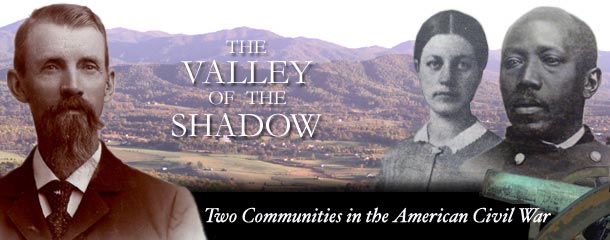
By any measure, Valley of the Shadow has been a phenomenal success. Over the course of a decade and a half, it has provided the catalyst for a host of books, essays, CD-ROM’s, teaching aids, and articles – not to mention more than a few careers. At times it seems that everyone and their mother in the digital history world has some kind of connection to Valley of the Shadow. The impact the project has had, both within and outside of the academy, is a bit overwhelming. In this light, I decided to revisit Valley of the Shadow with a more critical lens and examine how it has held up over the years.
At the bottom of the Valley‘s portal, it reads “Copyright 1993-2007.” There aren’t many academic sites that can claim that kind of longevity, but this also carries a price. In short, the website already feels a bit dated. The structure of the website is linear, vertical, and tree-like. The parent portal opens up into a choice between three separated sections: The Eve of War (Fall 1859 – Spring 1861), The War Years (Spring 1861 – Spring 1865), and The Aftermath (Spring 1865 – Spring 1870). Each of these are divided into different repositories of source material, from church records to tax and census data to battle maps. Clicking on a repository leads to different links (for instance, two links leading to the two counties’ letters). A few more clicks can lead to, say, a letter from Benjamin Franklin Cochran to his mother in which he leads off with the delicious detail of lived experience that historians love: “I am now writing on a bucket turned wrong side up.”
In this sense, the database is geared towards a vertical experience, in which users “drill down” (largely through hyperlinks) to reach a fine-grained level of detail: Portal -> Time Period -> Source Material Type -> County -> Letter. What this approach lacks is the kind of flexible, horizontal experience that has become a hallmark of today’s online user experience. If one wanted to jump from Cochran’s letter to see, for instance, battle maps of the skirmishes he was referencing or if local newspapers described any of the events he wrote about, the process is disjointed, requiring the user to “drill up” to the appropriate level and then “drill down” again to find battle maps or newspapers. This emphasis on verticality is largely due to the partitioned nature of the website, divided as it is into so many boxed categories. This makes finding a specific source a bit easier, but restricts the exploratory ability of a user to cross boundaries between the sites’ different eras, geography, and source types.
If different sections of the website are partitioned from one another, what kind of options exist for opening the database itself beyond the websites own walls? In October of 2009, NiCHE held a conference on Application Programming Interfaces (APIs) for the Digital Humanities, with the problem it was tackling outlined as follows:
To date, however, most of these resources have been developed with human-friendly web interfaces. This makes it easy for individual researchers to access material from one site at a time, while hindering the kind of machine-to-machine exchange that is required for record linkage across repositories, text and data mining initiatives, geospatial analysis, advanced visualization, or social computing.
This description highlights the major weakness of Valley of the Shadow: its (relative) lack of interactiveness and interoperability. A human researcher can access specific information from the website, but it remains a major challenge to employ more advanced digital research techniques on that information. Every database is inherently incomplete. But one way to mitigate this problem is to open up the contents of a database beyond the confines of the database itself. The following scenario might fall under the “pipe-dream” category, but it illustrates the potential for an online database: a researcher writes a programming script to pull out every letter in Valley of the Shadow written by John Taggart, search both the Valley‘s database and national census records in order to identify the letters’s recipients, capture each household’s location and income level, and use that data to plot Taggart’s social world on a geo-referenced historical map or in a noded social network visualization. Again, this might be a pipe-dream, but it does highlight the possibilities for opening up Valley of the Shadow‘s phenomenally rich historical content into a more interactive and interoperable database.
At the end of the day, Valley of the Shadow deserves every ounce of acclaim it has received. Beyond making a staggering array of primary sources available and accessible to researchers, educators, and students, it helped pave the way for the current generation of digital humanists. Valley of the Shadow embodies many of the tenets of this kind of scholarship: multi-modal, innovative, and most importantly, collaborative. Its longevity and success speaks to the potential of digital history projects, and should continue to serve as a resource and model moving forward.
1 I, for one, imagine the early days of digital history to be a rough-and-tumble wilderness, resplendent with modem-wrangling Mosaic cowboys and Usenet bandits.
A Term In Review
Yesterday I handed in my final papers to officially conclude my first academic quarter at Stanford. With that in mind, here are my initial thoughts on being a graduate student:
1. I read a lot.
I’ve never read this much in my life, and it took me most of the quarter to learn how to sit down and read books for hours and hours every day.

Given that this was my first term and that I was only enrolled in two reading-intensive courses, I’m a tiny bit terrified of what the future (cough, studying for orals) holds. Reading for so many hours has sadly all but demolished any inclination towards pleasure reading. On the flip side, I’ve gained a new appreciation for Hulu.
2. I’ve met amazing people.
It took me a little while to get used to the fact that I was surrounded by ridiculously intelligent people, including a classmate with his own Wikipedia page and an advisor who won a Macarthur Genius Award and who’s also way cooler than I am. All thirteen of my fellow cohort members are incredibly bright, inquisitive, and quite inspiring to think of as future colleagues. Everyone I’ve met outside of the history department has been just as impressive. Meanwhile, I have a blog that I struggle to update more than once a month.
3. I still don’t know what I want to study.
This is going to be a recurring problem. The downside to having a focus on digital methodology is that I have yet to figure out what I actually want to use that methodology to study. I don’t like the idea of confining myself to a narrow thematic topic, but it’s a step I’ll have to take eventually (one I plan on putting off for as long as possible). In the meantime, I’ll just have to keep answering the questions of “American history? Anything more specific?” with “Um, no. Not yet.”
4. I made the right decision.
Stanford has been a phenomenal fit so far. The best example I can give is that I had the opportunity to take a non-history course titled Literary Studies and the Digital Library taught by Matt Jockers. It was a seminar class in the English department, and included undergraduates, graduate students, and a fairly broad sample of various disciplines. The course centered around designing a digital text mining project to examine over one thousand American and British works from the nineteenth century, culminating in a three-paper proposal to the Digital Humanities 2010 conference in London (fingers crossed). Matt has since extended the course into the next quarter to let us continue to work on the project.
I could not have been happier with the course, and it embodies many of what I consider to be the core tenets of the digital humanities: hands-on technical problem-solving, interdisciplinarity, and intensive collaboration. I have almost no background in English – during class discussion I at one point googled “buildings romane,” which a helpful classmate had to correct to “Bildungsroman.” Despite this, or maybe because of this, I learned not only about cool things like epistolary novels and the rise of serialization, but also the differences in how literary critics and historians approach questions and problems. This interdisciplinary experience will serve me well in the future.
At the end of the day, I feel incredibly lucky to be given the opportunity to be doing something that I love. As one of my classmates said to me over lunch, “Isn’t it absurd that we’re somehow getting paid to be here?” Not yet jaded from TA’ing, orals, dissertation writing, or the job market, I could not agree more.


