Archive for December 2008
AHA-ing
This Friday marks the commencement of the 123rd annual American Historical Association’s meeting in New York City. I will be taking a bus up from D.C. on Friday morning, and will spend the next three days doing my best to: a) sit in on as many different sessions as possible, b) lower the average age of attendance, and c) contain my nerdy giddiness at seeing famous historians. I’ll be in the extreme minority of conference-goers, in that I can have a largely stress-free weekend – I have no job interviews, no papers to present, no potential colleagues I need to glad-hand.
In preparation, I’ve been doing some light blog reading on guides to the conference: at Tenured Radical, The AHA for Dummies, and at Edge of the American West, AHA interviews, redux. I’m also looking forward to fellow history bloggers’ paper sessions, including Sterling Fluharty on the history job market and Jana Remy on preparing for research trips.
Despite reading and hearing a whole wide range of complaints about the annual conference’s format, size, and usefulness, I’m still excited to attend. I’m looking forward to wandering around a gathering of thousands of historians and soaking in just exactly what I’ve gotten myself into by applying to graduate programs in history. I’m also going to try to listen to professors who I’ve applied to work with at various schools, and possibly introduce myself if the opportunity arises. Given the hectic bazaar-like nature of such a conference, this might be a challenge. On that front, I’d love to meet anyone and everyone reading this who will also be attending. If you’re interested, please send me an email.
Review: National Museum of American History
(Cross-posted at Progressive Historians)
On a cold Friday morning this past November, I set my alarm extra early, walked to the metro, and made my way to the ribbon-cutting ceremony for re-opening of the Smithsonian’s National Museum of American History. After staking out a position in the crowd next to the television crews, I was rewarded for a forty minute wait by turning around and coming face-to-face with Colin Powell, who was making his way to the stage flanked by security. I was too star-struck to say anything besides, “Good morning, sir,” although I did get to shake his hand on his way out. After a relatively short ceremony that included the national anthem and Powell reading the Gettysburg Address, they cut the ribbon and let the streaming crowds into the renovated and revamped museum. I took a brief walk around before realizing I was late for work. Today I finally had the chance to return to the museum for a proper exploration.
I had never been to the pre-renovation museum, but from what I’ve read it was relatively dark and cluttered. The new museum has largely addressed these issues, as the main lobby on the mall entrance is expansive, and wide glass skylights allow in ample sunlight to illuminate sleek architectural lines. Guests are funneled largely towards the crown jewel of renovation efforts: a multi-million dollar, state-of-the-art exhibit to house and display the Star-Spangled Banner. I was less than impressed with the exhibit. The visitor is first led down a hallway containing some basic background behind the story of the flag. The information was not conveyed very clearly, the lighting was too dim, and the wall screens displayed cheesy and surprisingly low-tech animations of the War of 1812. The part of the exhibit displaying the flag itself was a bit better, and it gave a very strong sense for the sheer size and weight of the flag (30 x 34 ft):

Next to the flag was a really well-done tabletop with a slowly scrolling and panning zoomed image of the flag, with small nodes/hostpots that the visitor could “click” to open up a infobox on various aspects of the flag. I thought the coolest part was that it gave the impression of a massive touch-screen, but all of it was in fact a projected image from above with an extremely sensitive sensor system that created a supremely dynamic and fluid interactive framework.
The next exhibit I walked through was the impressive “Within These Walls,” which leads the visitor around a partially reconstructed house from the town of Ipswich, Massachusetts:

Originally constructed in the mid-18th century, the house serves as a focal point for exploring its development through the next two centuries. My favorite aspect of the exhibit was an impressive use of written primary source material alongside the flashier material objects. Behind the array of medallions and tables, the walls themselves displayed important texts with pertinent sections highlighted. For example, one panel displayed a recorded will from one of the house’s residents that included a mention of Chance, a black house servant and former slave. This was a conscious decision on the part of the curator(s), as they begin the exhibition with an explanation of how historians find “clues” to examine the house. The exhibit does a great job of weaving together these clues, from allowing visitors to view a sample paint chip through a microscope to see its different layers, to enhancing an old map of the neighborhood with overlaid photographs and diagrams of a nearby mill and train depot. While a little bit simplistic, I was impressed at their efforts to make the process of historical research and discovery more accessible to a general public beyond, “Hey check out this sweet Gatling Gun!”
The next exhibit I explored was “Communities in a Changing Nation,” which uses three different communities (New England factory workers, Cincinatti’s Jewish enclave, and blacks in South Carolina) to examine 19th-century America:

In my opinion, “Communities in a Changing Nation” was less than impressive. It embodied a lot of the less appealing elements of a more “traditional” museum exhibit. Using a largely linear approach, with exhibits on either side of the hallway, it lacked both clarity and innovation. The exhibit assigned a matrix system of four broader themes to the three communities: Land and Abundance, Equality and Democracy, Freedom and Independence, and Progress and Opportunity. I didn’t even realize this thematic attempt until halfway through the exhibit, and even when I was aware of these themes, I had trouble identifying differences between them. Finally, the African-American community seemed a little patronizing. It included several life-like mannequins that didn’t work that well, especially considering that none of the other “communities” had similar displays. While not necessarily offensive, I don’t think it was done with particular subtlety or sensitivity.
If anyone has the chance to go to the museum in the next several weeks, I’d recommend seeing the White House copy of the Gettysburg Address, on loan only until January 4th, 2009. While the exhibit itself isn’t anything special, being able to see Lincoln’s handwritten copy of arguably one of the most famous speeches in American history is certainly special in and of itself.
Finally, my surprise favorite exhibit was “America on the Move,” a massive, winding exploration of transportation in America. I was largely skeptical as I entered through a doorway labeled “General Motors Hall of Transportation,” and prepared myself for overt championing of the automaking industry alongside a superficial, traditional, and commercialized presentation. Instead, I was greeted with a remarkably organic layout. Although a bit confusing for those who like linear, clearly organized exhibits, I soon discovered the joys of stumbling onto various nooks and corners and becoming utterly absorbed in individual sections. Public historians talk a lot of about allowing the visitor to explore a space for themselves, but it’s often difficult to achieve this goal. I felt that “America on the Move” managed to accomplish it.
As an example of one such instance of exploration, I inadvertently walked into a side-room that included two screens, one on a pedestal and another wall-sized display mounted above. On the smaller screen, the visitor could place pins onto a touchscreen map of the world, with each pin representing their lineage – where they, their parents, and their grandparents were born. Upon completion, the results were displayed on the larger screen before being added to an aggregate dot-image map displaying the results of every visitor’s participation. The composite image was a constantly-changing and growing database displaying museum visitors’ ancestries. The viewer was left not only with a larger sense of what constituted being “American,” but also a feeling of participation in a larger project.
I was impressed with the immersive aspect of “America on the Move,” largely made possible through the significant donations of a wide range of supporters (including, unsurprisingly, GM, AAA, Exxon Mobil, UPS, and Caterpillar). But there was an attention to detail that made it really fascinating – for instance, displays that included baskets of synthetic fruit to be transported actually smelled like fruit (or something like fruit). When the visitor stepped on board a model commuter bus, its vibrating machinery, moving images, and sharp sounds actually made them fell like a 1959 commuter. There is a fine line between overdone and cheesy special effects and those subtle touches that accomplish the goal of making the visitor feel like they are actually “there.” The exhibit did a great job of deftly navigating that line.
The Smithsonian National Museum of American History is faced with a daunting task: preserving and displaying our entire nation’s history. There is simply no way to adequately accomplish this task, and there will always be omissions and interpretative differences. But if the museum makes a real commitment to gather and respond to feedback from a variety of sources, to evolve and ask tough questions, and to continually self-improve beyond a $85 million physical renovation, then I am optimistic for its future as a publicly accessible gateway into examining America’s past.
Geeking Out with History
I’ve been meaning to blog about this for awhile, but last month the Digital Youth Project released the results of their three-year study: “Hanging Out, Messing Around, and Geeking Out.” The project, through funding from the John D. and Catherine T. MacArthur Foundation and collaborative scholarship between researchers in the UC system, looked to examine young people’s use and interaction with new media in three realms: communication, learning and play. The overall results are both fascinating and encouraging, and I’d recommend at least reading the two-page summary of their findings.
The title stems from the three modes of use the researchers identify. Hanging out is the primarily social interaction between friends and peers, exemplified by social networking sites, instant messaging, or text messaging. The second mode, messing around, is a form of digital exploration and expression, exemplified by uploading videos or photos, trying out different online applications, or passing along discoveries (think Elf Yourself or LOLCats, for two admittedly trivial examples). The final mode, geeking out, is diving into a specific topic, finding a community of like-minded enthusiasts, and working towards a degree of expertise in the area.
For anyone interested in youth participation in new media, reading the white paper is a must. K-12 educators with even a passing interest in what their students are doing should take a glance at it. Upon first skimming it, I thought it did a great job of refuting several commonly-held perceptions about young people’s activity online. First, under the hanging out topic, of particular note is the refutation of a still-pervasive myth that kids go online and end up primarily interacting with strangers. Instead, the researchers write, “With these ‘friendship-driven’ practices, youth are almost always associating with people they already know in their offline lives.” For the majority of young people, the idea of going into online chatrooms and striking up friendships with complete strangers is largely a relic of the past. With messing around, the researchers stress the fact that young people are not passive recipients of media, but they are increasingly participatory members of a community. There is a critical element of trial-and-error, as kids explore and incorporate (or reject) new activities. Finally, my favorite mode: geeking out. The authors highlight the important point that “one can geek out on topics that are not culturally marked as ‘geeky’.”
For some reason, this relatively innocuous assertion provoked a lot of thought on my end. “Geeking out” still carries strong cultural connotations, bringing to mind images of traditional nerd culture – see Timothy Burke’s recent post on Batman comics, in which he offers a disclaimer: “This entry is going to be the maximally geeky one.” But “geeking out” as a verb can increasingly apply to non-”geeky” subjects: sports-obsessed fantasy football participants, any and every kind of music enthusiast, political gossip and speculation, etc. This has been one of the true hallmarks of the internet, by breaking down barriers of entry into extremely specialized fields of interest.
Which leads me to the title of this post: historians need to take advantage of the digital landscape to geek out with history. Without any amount of exaggeration, I can confidently say that my own geeking out with history has contributed just as much to my identity as a “historian” as my semesters of traditional scholarly training. Subscribing to blogs or listening to podcasts will not replace formal instruction. But it can certainly enhance the learning process, and in my mind, offers a higher ceiling for immediate participation and access. If a student writes an essay for a college course, most of the time the only reader will be the professor, and possibly some fellow students if it is a seminar. Meanwhile, if a student takes that same energy and enthusiasm to their subject online, they read related thoughts from scholars around the world, exchange comments and dialogue with some of those scholars, or post that same essay as a blog and receive feedback from a much greater number of readers.
On the research side, I think many academics are awakening to the vast potential for vertical exploration of historical source material. Fifteen years ago, doing research on a historical subject meant countless trips to archives and libraries, excursions that were largely hindered by geographical and financial considerations. Today, digitization projects have greatly streamlined the process of finding and accessing this material. In doing so, it is opening up the door for anyone to geek out with history. Genealogists and armchair historians have always greatly contributed to the field, whether or not academics like to admit it. But in the years to come, the ability of non-professionals to do professional work will grow and grow. This is a double-edged sword, as greater participation enhances the possibilities for collective intelligence and collaboration, while also running the risk of suffering from a “Barnes and Noble Syndrome,” of an environment dominated by cream-puff analysis and a lack of vigorous interpretative context.
Academic historians need to get their hands dirty online. Read (and write) blogs, mine some data, listen to podcasts, enter a virtual world, upload media, explore databases, leave comments, and share your research. Take some chances and make mistakes. In short, geek out.
Naming the Crisis
How will future generations refer to the current financial crisis? When my grandchildren open up their history textbooks (assuming we still have such archaic things as textbooks, history classes, schools, or progeny), what will this event be called? A seemingly simple, parlor-game question actually sparks far more interesting issues of historical memory and commemoration.
That the Great Depression is called “The Great Depression” speaks to its severity and trauma within our national psyche. Much like the unseen, shadow-lurking monster of a horror movie, it’s lack of specificity (time, place, duration) makes it that much scarier. Was the Panic of 1873 originally referred to with a similarly ominous lack of specificity, and only later refined to make room for the more recent, “Great” depression? Does popular memory only have room for a handful of superlative events? Most people no longer refer to World War I as the Great War (or the the even less-accurate-in-hindsight “War to End All Wars”), precisely because it was eclipsed by World War II. Suddenly, assigning the “Great” label to WWI would seem like a disservice to the massive tragedy of WWII. One hopes that today’s credit crisis does not reach the epic proportions to similarly displace the saga of the 1930′s as our nation’s new Great Depression.
At what point do events transcend from being a present reality to a past event? This is an ongoing question for historians, but one that aptly fits to any major current event. There are some events that have a sharp and declarative starting and ending points (think 9/11 or JFK’s assassination). These seem to move into the realm of the past with a great degree of ease. Although Americans lived in a state of fear for the days and weeks after 9/11, waiting for another terrorist attack, the day itself seemed to become a memorialized event rather quickly. On the other hand, a small minority might argue (particularly Bush apologists) that 9/11 was actually the commencement of an ongoing war on terror, and therefore is not even in our past.
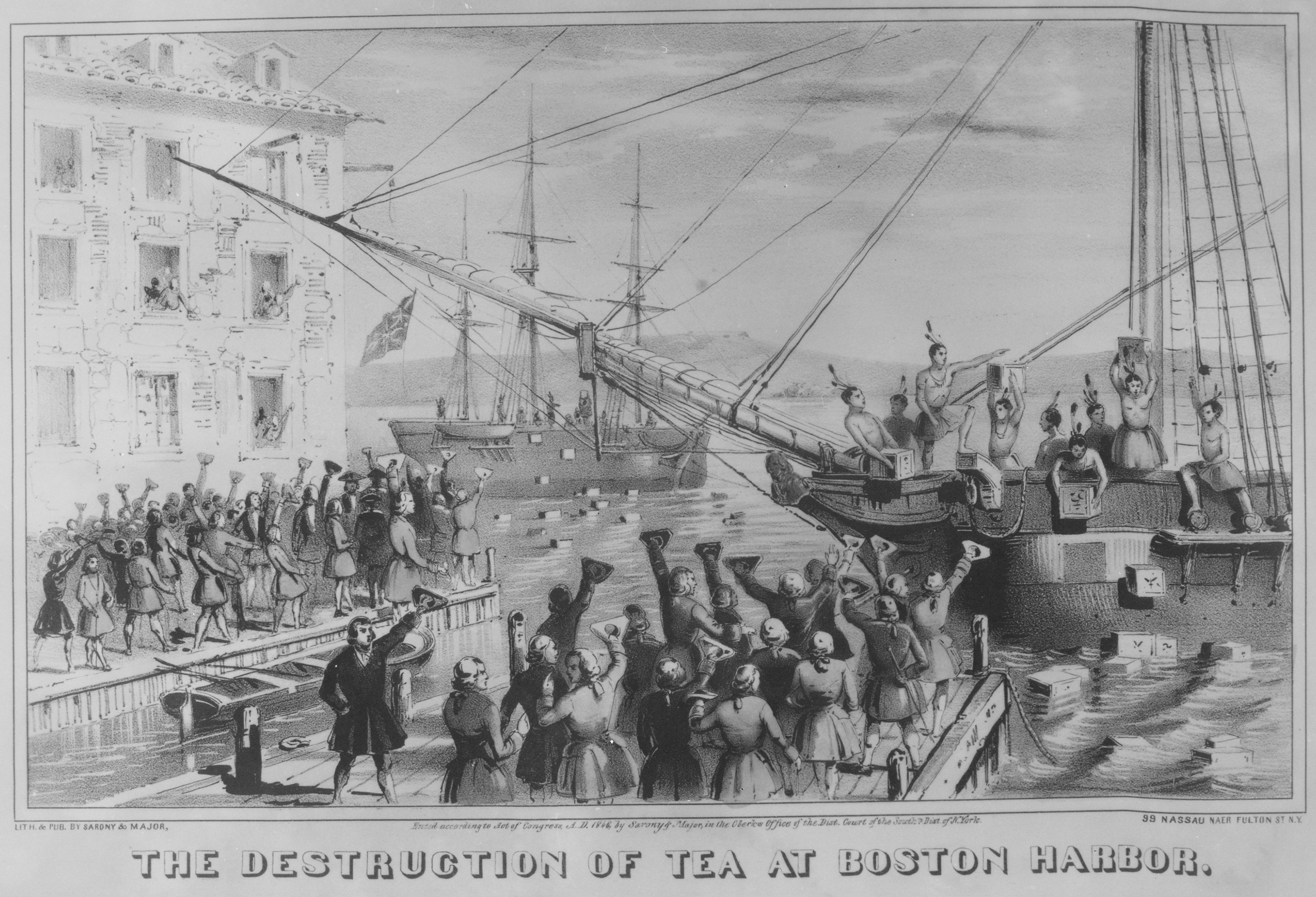
Even clearly bounded events can become murky within popular memory. One historical study of such an event that I particularly liked was Alfred Young’s The Shoemaker and the Teaparty: Memory and the American Revolution, which uses the life and experience of one relatively minor player in the Boston Tea Party to examine both the event itself and how it came to be commemorated. Young describes how the “Boston Tea Party” was not in fact called by this name until the 1830′s. Today it is one of the most well-known non-military events in popular American lore:
At the other end of the spectrum are those events that are not in fact events, but broader movements, transformations, or even eras. Naming these events proves just as problematic. “The Roaring Twenties” might have indeed been roaring, but has the name stuck primarily because of its contrast to the decades bracketing them? “The Gold Rush,” while colorful in every sense, uses a somewhat narrow term to describe a much broader movement of people. Some labels seem to come easier – “The Cold War” is about as widely-used and definitive as any other major era in American history. In comparison, we have yet to assign a commonly accepted moniker for the prosperous years of the 1990′s, beyond maybe the Clinton Years.
The question remains: what will the name become for the current financial crisis? Will it be “The Global Financial Crisis of 2008″ (according to Wikipedia)? “The Global Credit Crisis”? “The Banking Collapse”? Hopefully not “Armageddon” or “The End of America”. Naming the crisis will depend largely on the future – its duration, severity, and scope. Regardless, it is probably too late to hope that it will pass into the historical annals of minor events too unimportant to name. For better or for worse, it marks a turning point in American history.


