Author Archives: Cameron Blevins

Coding a Middle Ground: ImageGrid

Openness is the sacred cow of the digital humanities. Making data publicly available, writing open-source code, or publishing in open-access journals are not just ideals, but often the very glue that binds the field together. It’s one of the aspects of digital humanities that I find most appealing. Despite this, I have only slowly begun to put this ideal into practice. Earlier this year, for instance, I posted over one hundred book summaries I had compiled while studying for my qualifying exams. Now I’m venturing into the world of open-source by releasing a program I used in a recent research project.

The program tries to tackle one of the fundamental problem facing many digital humanists who analyze text: the gap between manual “close reading” and computational “distant reading.” In my case, I was trying to study the geography within a large corpus of nineteenth-century Texas newspapers. First I wrote Python scripts to extract place-names from the papers and calculate their frequencies. Although I had some success with this approach, I still ran into the all-too-familiar limit of historical sources: their messiness. Namely, nineteenth-century newspapers are extremely challenging to translate into machine-readable text. When performing Optical Character Recognition (OCR), the smorgasbord nature of newspapers poses real problems. Inconsistent column widths, a potpourri of advertisements, vast disparities in text size and layout, stories running from one page to another – the challenges go on and on and on. Consequently, extracting the word “Havana” from OCR’d text is not terribly difficult, but writing a program that identifies whether it occurs in a news story versus an advertisement is much harder. Given the quality of the OCR’d text in my particular corpus, deriving this kind of context proved next-to-impossible.

The messy nature of digitized sources illustrates a broader criticism I’ve heard of computational distant reading: that it is too empirical, too precise, and too neat. Messiness, after all, is the coin of the realm in the humanities – we revel in things like context, subtlety, perspective, and interpretation. Computers are good at generating numbers, but not so good at generating all that other stuff. My computer program could tell me precisely how many times “Chicago” was printed in every issue of every newspaper in my corpus. What it couldn’t tell me was the context in which it occurred. Was it more likely to appear in commercial news? Political stories? Classified ads? Although I could read a sample of newspapers and manually track these geographic patterns, even this task proved daunting: the average issue contained close to one thousand place-names and stretched more than 67,000 words (or, longer than Mrs. Dalloway, Fahrenheit 451, and All Quiet on the Western Front). I needed a middle ground. I decided to move backwards, from the machine-readable text of the papers to the images of the newspapers themselves. What if I could broadly categorize each column of text according both to its geography (local, regional, national, etc.) and its type of content (news, editorial, advertisement, etc.)? I settled on the idea of overlaying a grid onto the page image. A human reader could visually skim across the page and select cells in the grid to block off each chunk of content, whether it was a news column or a political cartoon or a classified ad. Once the grid was divided up into blocks, the reader could easily calculate the proportions of each kind of content.

My collaborator, Bridget Baird, used the open-source programming language Processing to develop a visual interface to do just that. We wrote a program called ImageGrid that overlaid a grid onto an image, with each cell in the grid containing attributes. This “middle-reading” approach allowed me a new access point into the meaning and context of the paper’s geography without laboriously reading every word of every page. A news story on the debate in Congress over the Spanish-American War could be categorized primarily as “News” and secondarily as both “National” and “International” geography. By repeating this process across a random sample of issues, I began to find spatial patterns.

Grid with primary categories as colors and secondary categories as letters

For instance, I discovered that a Texas paper from the 1840s dedicated proportionally more of its advertising “page space” to local geography (such as city grocers, merchants, or tailors) than did a later paper from the 1890s. This confirmed what we might expect, as a growing national consumer market by the end of the century gave rise to more and more advertisements originating from outside of Texas. More surprising, however, was the pattern of international news. The earlier paper contained three times as much foreign news (relative “page space” categorized as news content and international geography) as did the later paper in the 1890s. This was entirely unexpected. The 1840s should have been a period of relative geographic parochialism compared to the ascendant imperialism of the 1890s that marked the United States’s noisy emergence as a global power. Yet the later paper dedicated proportionally less of its news to the international sphere than the earlier paper. This pattern would have been otherwise hidden if I had used either a close-reading or distant-reading approach. Instead, a blended “middle-reading” through ImageGrid brought it into view.

We realized that this “middle-reading” approach could be readily adapted not just to my project, but to other kinds of humanities research. A cultural historian studying American consumption might use the program to analyze dozens of mail-order catalogs and quickly categorize the various kinds of goods – housekeeping, farming, entertainment, etc. – marketed by companies such as Sears-Roebuck. A classicist could analyze hundreds of Roman mosaics to quantify the average percentage of each mosaic dedicated to religious or military figures and the different colors used to portray each one.

Inspired by the example set by scholars such as Bethany Nowviskie, Jeremy Boggs, Julie Meloni, Shane Landrum, Tim Sherratt, and many, many others, we released ImageGrid as an open-source program. A more detailed description of the program is on my website, along with a web-based applet that provides an interactive introduction to the ImageGrid interface. The program itself can be downloaded either on my website or on its GitHub repository, where it can be modified, improved, and adapted to other projects.
Pilgrims, Cowboys, and Loneliness

The provocative title of Stephen Marche’s Atlantic article, “Is Facebook Making Us Lonely?” invites immediate skepticism as the latest iteration in the sub-genre of technological alarmism about the internet. Like much of this literature, Marche’s writing is far more thoughtful and measured than his simplistic title would indicate. He admits, for instance, that “Loneliness is certainly not something that Facebook or Twitter or any of the lesser forms of social media is doing to us. We are doing it to ourselves.” He also makes the interesting point that Facebook requires a relentless and exhausting performative dance on a digital stage. But he also makes some problematic claims. A range of responses have critiqued Marche’s use of studies and statistics, but what caught my eye was Marche’s use of history. In one passage, worth quoting at length, Marche writes:

Loneliness is at the American core, a by-product of a long-standing national appetite for independence: The Pilgrims who left Europe willingly abandoned the bonds and strictures of a society that could not accept their right to be different. They did not seek out loneliness, but they accepted it as the price of their autonomy. The cowboys who set off to explore a seemingly endless frontier likewise traded away personal ties in favor of pride and self-respect. The ultimate American icon is the astronaut: Who is more heroic, or more alone? The price of self-determination and self-reliance has often been loneliness. But Americans have always been willing to pay that price.

…

Self-invention is only half of the American story, however. The drive for isolation has always been in tension with the impulse to cluster in communities that cling and suffocate. The Pilgrims, while fomenting spiritual rebellion, also enforced ferocious cohesion. The Salem witch trials, in hindsight, read like attempts to impose solidarity—as do the McCarthy hearings. The history of the United States is like the famous parable of the porcupines in the cold, from Schopenhauer’s Studies in Pessimism—the ones who huddle together for warmth and shuffle away in pain, always separating and congregating.

I always get annoyed when historians mount their high horses to harumph about how Americans don’t know anything about history. But indulge me for one paragraph while I do just that. There are two major problems with Marche’s use of history here. First, it’s inaccurate. There’s a big difference between “loneliness,” “independence” “self-determination” and “self-reliance,” but Marche seems to conflate them all together. The Pilgrims were more about religious reform than religious independence, and leaving one place for another place doesn’t make you lonely. Or alone. Or independent. Or self-reliant. As Marche himself admits, they also pursued their “spiritual rebellion” in an intensely communal manner.

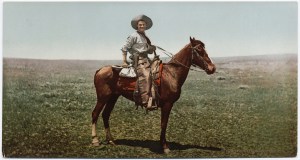
Then there’s the cowboys. Oh boy. A generation of “New Western Historians” have pretty conclusively dispelled the idea of the self-reliant, independent wrangler. Cowboys were always deeply reliant on others: the federal government to remove plains Indians and enforce ranching and riparian rights, or a host of merchants, storekeepers, and meat-packers that inextricably tied them to national and international markets. And I don’t even understand what “traded away personal ties in favor of pride and self-respect” even means.

Image courtesy of Yale Collection of Western Americana, Beinecke Rare Book and Manuscript Collection

My problem is less with the accuracy of Marche’s history but in how he uses it. I don’t expect an article in the Atlantic to delve into the historiographical intricacies of the Puritans or the problematic nature of Frederick Jackson Turner’s frontier thesis. What Marche is talking about is American mythology, not some “core” of the American character or “actual” history. If he had made this distinction clearer, it’s a quite relevant and important point. Independence, self-reliance, self-determination: these are cherished ideals that undergird many of the stories Americans tell themselves about their past. And it’s fascinating to think about how these ideals interact with the separate (but related) reality of both loneliness and community in a present-day context.

Alexis de Tocqueville tackled this paradox between individualism and communalism two centuries ago in Democracy in America. The French political thinker toured America in 1831 and wrote an expansive account of American institutions, history, society, and character. A major theme running through Democracy in America was the tension between the individualism produced by a society based on equality with institutions and associations based on communal life. De Tocqueville argued that social equality had the downside of producing immensely self-centered people. In true de Tocqueville fashion, he penned one passage that has a ring of timelessness to it – Marche could have used it word-for-word in his characterization of present-day loneliness:

The first thing that strikes the observation is an innumerable multitude of men, all equal and alike, incessantly endeavoring to procure the petty and paltry pleasures with which they glut their lives. Each of them, living apart, is as a stranger to the fate of all the rest; his children and his private friends constitute to him the whole of mankind. As for the rest of his fellow citizens, he is close to them, but he does not see them; he touches them, but he does not feel them; he exists only in himself and for himself alone; and if his kindred still remain to him, he may be said at any rate to have lost his country.

But de Tocqueville goes on to describe how American society during the Jacksonian era combated the effects of isolation brought about by social equality, perhaps most importantly through associational life: “In no country in the world has the principle of association been more successfully used or applied to a greater multitude of objects than in America. ” Americans in the 1820s and 1830s loved forming groups: political parties, religious sects, reform movements. This was the age of Joseph Smith and Mormonism, massive evangelical revivals, temperance movements, and the American Anti-Slavery Society. So what does it say that one of the most famous historical observers of American society highlighted the intense communalism of that society? My point is not that de Tocqueville was right or wrong, it’s that Americans and critics of American society have always wrestled with the balance between communalism and individualism.

A lack of historicity is my major problem with “Is Facebook Making Us Lonely?”. Marche uses history as a vague, unexamined point of departure for the present, oftentimes veering into  trope of a lost “Golden Age.” He cites some studies demonstrating, for instance, that the number of households with one inhabitant has increased from 1950, or that the number of personal confidants decreased from the 1980s to the present. Although Eric Klinenberg thoughtfully disputes Marche’s claim that “various studies have shown loneliness rising drastically over a very short period of recent history,” I’m less concerned with the accuracy of Marche’s claims than his treatment of history itself.

There’s a tendency when writing critiques of present-day society to make a direct implication that things are fundamentally new and are changing for the worse. And this tendency seems to be even more prevalent in diatribes against technology, which operate under an often-unexamined assumption that technology X (the telegraph, the automobile, the Internet, social media) has irrevocably reshaped our world. It’s useful to talk about the effects of technological changes: there are many ways in which Facebook and social media has, in fact, fundamentally changed our society. But too often these articles assume that any and every change is a) something fundamentally new, and b) directly attributable to the technology itself. Marche neatly encapsulates this lack of historicity in two sentences: “Nostalgia for the good old days of disconnection would not just be pointless, it would be hypocritical and ungrateful. But the very magic of the new machines, the efficiency and elegance with which they serve us, obscures what isn’t being served: everything that matters.”

Facebook isn’t magic and the “good old days of disconnection” only exist in our historical imagination. Not only do cowboys have an American Professional Rodeo Association, the group has its own Facebook page. As de Tocqueville reminds us, we’ve wrestled with the contradictions between loneliness, individualism, and communalism for a long, long time. What Facebook has done is change some of the channels and format of these tensions. Like any technology, it needs to be more thoughtfully placed in its historical context. History is not a golden age or a black box or a passive point of departure for a completely new paradigm. Critics of Facebook or Twitter or whatever new technology will be undermining the “American core” in twenty years should do a better job of keeping this in mind.

Giving It Away

Earlier this year I uploaded a little over one hundred book summaries onto my website. The short summaries were in many ways the culmination of hundreds and hundreds of hours of reading, note-taking, and studying that I had done in preparation for my qualifying exams. At the end of the process I thought about all of that work that had gone into them and realized that it would be a shame to simply file them away for my own personal use. I might post them to Stanford’s internal history graduate archive, I might forward a few to colleagues or students, but that’s about it.

Book summaries of this kind represent an odd gray zone in the humanities. They’re a slightly more refined version of the scribbled notes that all of us take during classes, workshops, conferences, and colloquia. They aren’t critical reviews meant to stimulate evaluation and debate. They aren’t scholarship. They are certainly not anything I would put in a tenure file. Instead they’re the boring, nuts-and-bolts side of being an historian – ingesting several hundred pages of material and condensing it into a short, schematic summary. But this gray zone is also an important part of our profession. It’s what quals are all about: establishing a command (however tenuous) over the literature in the field. I hear laments all the time about how difficult it is to maintain that command, to keep all of the books in your field crammed into your head. My aim in making these summaries available is to try and aid that process on a superficial level. Nobody is going to be able to write a paper or teach a lecture using these summaries. But they do serve as a quick-and-dirty reference tool: “I keep seeing Kathy Peiss’s Cheap Amusements cited by urban historians. What exactly was it about?” Reading a short, four-hundred word schematic can be a lot faster and easier to digest than searching JSTOR for scholarly reviews, many of which offer only a brief summary of arguments before launching into historiographic debates or evaluative criticism.

I had some minor hesitation about putting the book summaries online. These were written for my own use and, I’m certain, contain the types of inevitable errors that originate from trying to churn out two books a day during the crunch-time of studying for quals. What if I had mischaracterized someone’s argument? What if I missed their point entirely? What if colleagues or job committees or (shudder) the actual author stumbled across those errors? All of these concerns are, of course, patently absurd. The idea of Amy Dru Stanley actually finding, reading, and taking offense at how I summarized her concept of postbellum contract ideology is laughable. More philosophical concerns involve a broader critique of the superficiality of the internet: when you can find everything at the click of a button, what incentive is there to actually learn things on your own? Despite my obvious embrace of technology, I have some sympathy for this viewpoint. The countless hours of reading and synthesizing that went into studying for quals was as valuable (if not more so) for developing the skill of reading books as it was for the content of the books themselves. Yes, a college freshman might take the lazy route and write a (poor) final paper based largely off of these summaries, thereby cheating themselves out of a valuable experience of learning to read and write effectively. But ultimately I had the same reaction to this concern as I did for related critiques of the digital “culture of distraction”: closing off content is not the answer to the problem.

Which brings me to the title of my post: “giving it away.” Like many in the digital humanities, I advocate for openness: open access, open data, open source. This commitment to openness is one of the hallmarks of a field dedicated to collaborative research and expanding the definition of scholarship. But I’m less concerned with humanists who know how to code or are self-professed THATCamp junkies than I am with people who will never attach the “digital” label to their title. While proselytizing digital humanists sometimes exaggerate the closed-off nature of “traditional” humanities into a straw-man, the fact remains: there isn’t a clear non-technical-humanities avenue for, say, uploading KML files onto GeoCommons or releasing a Ruby script on Sourceforge. A journal article or a monograph represents hundreds and hundreds of hours of work. Yet in the end, all of those notes and documents and transcripts and photographs usually end up just sitting on someone’s hard drive. We don’t have an established model for making them available.

For example, when I was doing research on free blacks in colonial New England, I photographed and transcribed dozens of property deeds from town vaults. I reference many of these in the endnotes of an article, but this is only useful to someone who is able to travel to the local archives of Haddam, Connecticut, pull out a volume of property deeds, and laboriously pore over the hand-written pages. What about a genealogist tracing family roots to central Connecticut? Or a researcher looking into colonial rural debtor patterns? Being able to see and read the documents on their computer is a lot more useful than trying to follow the breadcrumb trail of scholarly endnotes. And that doesn’t even touch on all of the transcriptions and sources that I didn’t end up using in the article. I see this kind of material in the same light as my book summaries: they aren’t original scholarship, but they are a crucial component of my work as an historian that should be shared.

I’m not calling for a robust online repository where people like me can upload humanistic material. I know juuuuust enough about digital archiving to know that this kind of proposal is far, far more complex anyone (myself included) might imagine. Instead, I’m simply calling for humanities scholars to give more things away. I’m less concerned with the particulars of how it’s done than the broader culture that accompanies it. I don’t expect busy professors with limited technical expertise to spend hours and hours formatting their material, meticulously attaching metadata, or publicizing its availability. Archivists and open-access champions might shudder at the thought of individual people tossing poorly-documented material into isolated, worryingly ephemeral online silos. But I think the very process of making things available on an individual level, however ad-hoc or clumsily executed, is an important step for a discipline without a strong culture of openness. The broader humanities (not just the digital humanities) need to develop a stronger disciplinary habit of giving things away.

Surviving Quals, Part II: The Grind

*This is part two of a series on preparing, studying for, and taking qualifying exams in a history PhD program. See Part I here. After taking my exams in December 2011, I decided to collect my thoughts on the process. The following advice is based on my own experience of taking Stanford’s qualifying oral exams for United States history. The format was a two-hour oral exam, with four faculty members testing four different fields: three standard American history fields (Colonial, Nineteenth Century, and Twentieth Century) and one specialty field (in my case, Spatial and Digital History). Bear in mind that other programs have different purposes, formats, and requirements.*

The Grind

“Preparing for quals is a full-time job, but there is no reason to put in overtime.” This was one of the best pieces of advice I received when I was asking fellow graduate students about the process. More so than perhaps any other facet of graduate school, studying for quals should be managed like a job. This is for two reasons: to keep pace and to keep sane.

Keep Pace

Quals can be thought of as a simple math problem with two main variables. One variable is the total number of books you need to read. The other is how much time you have to read them. If you have an exam date already set, work backwards to figure out how many books you need to read each week. If you have more control over scheduling the date of the exam, work forwards. Using a baseline of around 3-4 hours for each book, determine how many total hours you will need to read them. In either case, it’s crucial to factor in additional time for things like basic chronology, reviewing material, and meetings with professors (roughly 30-40 hours per field, in my case). Schedule in other commitments, weekends, vacations, or time off depending on your schedule. Finally, add in an additional 2-3 week buffer before the exam. This gives you crucial time to synthesize all of the material and, worst case scenario, a surplus buffer of time to dip into if you get behind on your reading schedule. Add it all up and you’ll get a rough sense for what your pace needs to be. In my case, I ended up having to read roughly 8-9 books a week, with around eight hours of additional preparation each week.

Once you’ve figured out what your pace is, you need to keep track of your progress. I ended up creating a spreadsheet with all of my books and estimates for how much time I’d need on each book (usually 3-4 hours for a normal monograph, several more hours for a synthetic tome like Daniel Walker Howe’s What Hath God Wrought). This gave me a running tally of my progress and how much still remained – unsurprisingly, this was a daunting list in the beginning. But checking off books became a daily ritual that lent an all-important sense of moving forward. Having a schedule also gives you added structure for an experience that can otherwise be dangerously unaccountable. There are days when you will be tired, distracted, or just sick and tired of turning pages. These are the days when lack of daily accountability becomes a problem. Putting off a book one morning might seem trivial at the time, but it adds up quickly. Having a schedule forces you to keep working. It might not be pretty, you might not retain as much from that particular book, but knowing that you have to get through it to reach your “quota” for the week allows you to keep grinding.

Keep Sane 

Treating quals-studying like a job that you clock into and out of also helps to keep your sanity. Just reading and reading for hours every day is an isolating and tiring experience in a way that taking classes, teaching, or even research is not. It’s easy to get lost in the world of endless books, and while this can be rewarding in its own peculiar way it’s also not sustainable. Set a daily reading schedule and try to stick with it. By working consistently at the same times each day it will be much easier for you to “leave” your job. When you’re done for the day, actually be done for the day. I found studying for quals to be draining in a very different way from other aspects of graduate school. Whereas I have no problem answering emails from students at night or thinking about research while I cook dinner, it was much more exhausting to think about the two books I had read that day for quals. If possible, try to take at least one day off a week where you don’t touch a book. And all of the other rules about work/life balance apply: have a social life, exercise, think and talk about things other than history. Clock in, clock out.

Learn How to Not Read

Arguably the most important skill in studying for quals is learning how to not read. When you have to read two books a day, you don’t actually read them. You gut them. Graduate school has likely forced you to begin to do this already, but it will soon become a standard rather than an exception. For inspiration, read Larry Cebula’s “How to Read a Book in One Hour.” Although you will be spending more time on each book, the same general principles apply. Below was my own system for reading a book for quals.

1. Use a template. After much debate I ended up using Evernote as my note-taking medium. I created a basic template that I would use to create a new note for each book. This not only saves time but allows you to remember information more systematically. Finally, taking notes digitally also allows for a more robust catalog and search functionality, especially via tagging systems. By tagging summaries of books with their different subjects, I could quickly pull up, say, all the books on my 19th-century reading list having to do with slavery.

*Download my empty template in Evernote format or as an HTML file, or see an example of a completed note.*

Screenshot of note-taking in Evernote, with Tags and Searches highlighted

2. Use book reviews. Read 2-3 reviews of the book and take notes on them. If possible, try to find a mix of shorter (1-2 page) synopses and lengthier (5-10 page) reviews. You will quickly learn which journals are best for your particular field – in US History, for instance, Reviews in American History offers much more detailed reviews that oftentimes place the books within a broader historiographic context. I would usually pair one of these longer reviews with two shorter ones. By reading several different reviews you can usually glean what the “consensus” is on the book’s major themes and contributions and be on the look-out for these while reading.

3. Be an active reader. I’m aware people have different styles. But for quals, I found the best way to take notes was to sit at a desk with my computer and take notes on every chapter as I went. Whereas in classes I had often read books lying on a couch and used marginalia and underlining, I’ve since soured on this approach. Actively taking notes while you read is less enjoyable, but forces you to synthesize as you go. It’s easy to underline an important sentence without actually understanding it. Paraphrasing forces you to actually get what you read. As for content, start with a careful, word-by-word reading of the introduction and take detailed notes. Then move much more quickly through the book’s chapters, skimming and trying to pull out what’s most important.

Quals tend to privilege arguments over thematic content: few people are going to ask for the specific evidence an author used to support their argument in a particular chapter. However, jotting a sentence down that describes the general setting, actors, and subject of the chapter, separate from its argumentative thrust, allows you to recall it better in the future. It’s important to take notes on both arguments and content. Finally, move fast. Flip past pages that are simply listing additional evidence for an argument. Although these are often the most enjoyable parts of history books they are, unfortunately, tangential to why you’re reading the book. Unless the book was particularly long or particularly important, I tried to cap the reading part of the note-taking process at around three hours.

4. Synthesize. This is crucial. After reading every book I forced myself to take 20-30 minutes and write a careful two-three paragraph summary of the book. This is much harder than simply taking notes because it forces you to distill a book into its barest bones. Perhaps not surprisingly, it’s difficult to write a summary of a book you don’t understand or remember, so doing this also makes sure you actually processed what the author was trying to do (or force you to at least take a stab at it). As a supplement to this, as I was reading the book I would write major themes or concepts in a bullet list. Once I got to the end, I would go back and decide which of these were actually major themes or concepts and which ended up being auxiliary. The important themes gave me a basic skeleton from which I could then write a more elaborate summary. These write-ups proved invaluable. When you’re reading two books a day, even a book you read two weeks ago can dissolve into a distant memory. These summaries give you a fast and efficient means of recalling what the book was about. Finally, go back and revise them as you read other books. Oftentimes you don’t understand the broader significance of an author’s argument until you’re able to place it in a larger historiographic context.

* See an example of a full note here. Also see my full listing of book summaries for my US history fields.*

5. Talk it out. This is probably the hardest step, especially in the beginning of the process. But it’s central to studying for quals. There is something about having to verbally articulate an answer that forces you to understand it in a way that simply writing answers or notes does not. Additionally, one of the most challenging parts of quals is to move beyond simply being able to regurgitate a specific author’s argument and move towards higher-level synthesis. It’s one thing to be able to answer: “What is Bernard Bailyn’s interpretation of the American Revolution?” or even “What are three different interpretations of the American Revolution?” It’s much harder to answer, “Was the American Revolution actually revolutionary?” Answering these higher-level questions out loud is hard, but it is a skill at which you can and will get better. Once again, rely on your fellow graduate students, particularly ones who have already taken their exams. Have them ask you practice questions, pretend you are in an actual exam, and give formal answers (rather than the easier route of making it conversational, as in “Well, I’d probably say something about…”). Practice your own answers, but also ask other students for clarifications about topics or books you don’t understand. Do this as early as possible and keep doing it throughout the process. I found it the most useful way to prepare for the exam itself.

6. Go back to the basics. My grasp of the more factual side of American history was surprisingly weak going into the process. It’s easy to spend all of your time learning about historiography and interpretations, but you need a factual framework to build off. Particularly important episodes demand a solid grounding in chronology – for example, the lead-up to the American Revolution or the Civil War. Memorize things like changing geography, presidential administrations, dynastic reigns, economic depressions, major legal cases, etc. Some books, like those in the Oxford Series in American History, offer more nuts-and-bolts information than others. In this case, be aware of that and take more time to read them in more detail, writing separate notes related to basic chronology or events in addition to your notes on the more interpretive side of the book.

Surviving Quals, Part I: Laying the Groundwork

*This is part one of a series on preparing, studying for, and taking qualifying exams in a history PhD program. After taking my exams in December 2011, I decided to collect my thoughts on the process. The following advice is based on my own experience in taking Stanford’s qualifying oral exams for United States history. The format was a two-hour oral exam, with four faculty members testing four different fields: three standard American history fields (Colonial, Nineteenth Century, and Twentieth Century) and one specialty field (in my case, Spatial and Digital History). Bear in mind that other programs have different purposes, formats, and requirements.*

Laying the Groundwork (Or, Helping Your Future Self)

From a big-picture standpoint, studying for qualifying exams begins as soon as you start your graduate program. I mean this largely in a meta-sense: you should not be constantly thinking about your quals as a first-semester graduate student, but the classes you are taking, the papers you are writing, the courses you are TAing, are all building your knowledge base. On a more logistical standpoint, you should figure out the details of exams early on: what are the requirements, what the process is generally like, what the deadlines and dates are, who serves on your committee, etc. Which brings me to my first recurring theme:

Theme #1: Ask for Help

Talk to students who have already gone through or are currently going through the process. Department guidelines and handbooks are helpful, but actual students can usually tell you exactly what will happen and what you’ll need to do. Is there a department policy that is particularly onerous? Are credit requirements set in stone, or are they more flexible? Talking to students will give you a better sense for what all you need to do in a way that is often more directly relevant than talking to professors or administrators.

In the classroom, it’s crucial that you take systematic notes. This might seem straightforward. It’s not. There will be many, many weeks where you are swamped by papers, reading, or grading. These are the weeks when it’s much easier to underline and scribble just enough notes in the margin of a book to get through the day’s discussion rather than systematically writing it down. Don’t. Two years later these marginalia that made sense at the time are often barely helpful. Similarly, I’ve found that graduate seminars encourage a different kind of analysis than qualifying exams. In courses you usually talk about a book within a few days of reading it, dissect the book in a discussion setting (often with a graduate student enthusiasm for viciously ripping it apart), and then immediately setting it aside to move on to the following week’s reading. Studying for exams is much more about synthesizing and retaining massive amounts of information and big ideas. Which brings me to my second recurring theme:

Theme #2: Get Organized

Qualifying exams are often as much about persistence and organization as they are about intellectual firepower. Each person has different styles of note-taking, but for studying purposes active synthesis is absolutely crucial. To this end, I would taking 15 minutes after you’ve read and discussed a book to write up a short, 2-3 paragraph summary. I cannot over-emphasize how helpful these summaries will be – unless you are blessed with an extraordinary memory, the particulars of a book will often fade in a matter of weeks or months. Keeping the summary short forces you to consider what the major contributions and points of the book are. Take notes in class discussions about relevant context or historiography, and keep these notes alongside your summary. Your future self will thank you immeasurably.

The process of composing your reading lists will vary from program to program and professor to professor. My experience consisted of me coming up with a draft reading list for each field, submitting it to my committee member for review, and then incorporating their revisions. Regardless of the specifics, always refer to Theme #1: Ask for Help. Nobody sits down and comes up with a list from scratch. Go through as many reading lists from older graduate students as you can and you will start to get a sense for which books are part of the “canon” (for instance, Winthrop Jordan’s White Over Black was on every single list I consulted). For some reference, here were my reading lists for Colonial, Nineteenth-Century, and Twentieth-Century U.S. History.

An important note on this stage of the process: this is the fun part. If you’re in a history graduate program for the right reasons, you will be giddy thinking about all these cool books you want to read. This is wonderful, but don’t get carried away. It is easy to put every book you’ve ever wanted to read on the list. Don’t. Adding an extra book here and there seems harmless, but they add up quickly. And when you realize your exam is a month away and you’re fourteen books behind schedule you’ll be kicking yourself for adding in so many extra readings. This ties into my third theme:

Theme #3: Be Efficient 

To winnow it down, ask older graduate students about which are most valuable. Which books are particularly versatile or useful? Are there books they absolutely loved or hated? A book like Robert Self’s American Babylon allows you to answer a wide range of topics related to post-World War II America: metropolitan development, suburbanization, the rise of conservatism, race and identity politics, spatial history, and civil rights. Do you have multiple books covering the same topic? If so, which one(s) should you jettison? For instance, I included both Ira Berlin’s Many Thousands Gone and Philip Morgan’s Slave Counterpoint. Both are fantastic books, but in retrospect there was too much overlap between them. For the purpose of quals I wished I had substituted another book on colonial slavery for the seven-hundred page Slave Counterpoint that offered a much more different approach. Whenever you engage in a give-and-take with your committee member for a particular list, be firm. If you really want to include a particular book or think that the list is getting too long, lobby as strongly as you can to change it. Some professors will give you more leeway than others, but regardless do as much as you can to shape the list into what you want it to be. Which is all a part of my fourth theme:

Theme #4: Own It

Graduate students are endlessly warned about choosing a dissertation topic that they truly love. The same advice should be applied to reading for quals. Take the time to really think about what you want to get out of the entire experience. Figure out what the purpose is supposed to be. Stanford’s process is geared much more broadly towards preparing its graduate students to teach American history. Other programs aim to give you a mastery of the literature related more narrowly to your research agenda. Whatever the purpose, think long and hard about what specifically you want to emerge with. This can be as broad as “designing a survey course on colonial America” or as narrow as “finally understanding the Progressive Era.” Quals are an often-onerous academic hoop for you to jump through, so you might as well try to make it as valuable and enjoyable a hoop as you can.

Kobe Bryant and the Digital Humanities

What does one of the most successful and polarizing basketball players in history have to do with the digital humanities?

For those that don’t follow the NBA, Kobe Bryant is famous for a host of accomplishments: winning five championships, league MVP honors, and an Olympic gold medal, leading the league in scoring twice, winning the All-Star dunk contest, and scoring the second most points in a single game in history. He has also been accused over the years of placing personal success ahead of the team, undermining teammates and coaches, and most notoriously, of sexual assault in 2003. From a basketball standpoint, however, one of the most enduring aspects of Bryant’s career has been an overwhelming consensus of his ability as a “clutch” player. There exists a widespread perception that no other basketball player on earth is better at the end of close games. Both NBA players and general managers have repeatedly and overwhelmingly voted Bryant as the player they would want taking a shot with the game on the line. Bryant’s name and legacy have become entwined with the word “clutch.”

Unfortunately, this is a flawed narrative. Henry Abbott recently wrote a blistering (and persuasive) analysis of Bryant’s abilities as a “clutch” player. Abbott concludes that, by nearly every statistical measure he examined, Bryant is not the best in the world at scoring points at the end of close games. Depending on the metric, Bryant is somewhere between decent and very good, but nowhere close to the best. Perhaps most damningly, the effectiveness of his team’s offense (the best in the league during Bryant’s tenure) plummets at the end of games.

So the question remains: what does Kobe Bryant have to do with the digital humanities?

The fault line in the basketball world over Kobe Bryant’s “clutchness” largely falls between those that evaluate Bryant’s ability by what they see and those that evaluate his ability by what they measure. For someone watching Bryant, no other player has as many breathtaking, memorable game-winning shots and no other player looks as graceful and impressive while doing it. I draw a parallel between this qualitative analysis with more traditional humanistic research: we read our sources and look for meaningful or interesting patterns that jump out at us. On the other side of the basketball fault-line stands a young but growing movement that advocates for more rigorous statistical analysis of basketball, in the same vein as the sabermetric “Moneyball” movement in baseball. For these stat-heads, the seductive aesthetic appeal of Bryant’s game-winning shots hides the less glamorous reality: that Bryant misses those game-winning shot attempts at an extremely high rate. And this is the side of the debate that I would compare to the digital humanities.

The analogy isn’t perfect. Much of the work being done in the digital humanities field is not, in fact, quantitative (and making the comparison brings to mind the less-successful turn towards quantitative history in the 1960s and 1970s). But the analogy does have  some useful parallels. Like the stats movement in the basketball world, digital humanities has a lengthy history but has only recently begun to gain traction across the wider academy. Like the stats movement in the basketball world, digital humanities is occasionally seen as threatening or, at the very least, promising too much. Like the stats movement in the basketball world, there are those in digital humanities that revel in revisionism and using new techniques to challenge conventional narratives. And like the stats movement in the basketball world, there are divisions within the digital humanities over method, approach, and emphasis.

One of the most important parallels to be drawn is how the digital humanities are increasingly being used to strengthen (rather than replace) traditional humanistic study, just as advanced statistics are being used in the NBA to strengthen analysis. In the past, a basketball player would be evaluated by a handful of traditional statistics, perhaps most importantly: how many points do they score? Today, teams and scouts are looking at more advanced metrics: for instance, how efficiently do they score those points? In the same vein, traditional literary history might look at a handful of canonical works in order to draw broad conclusions about, say, early-19th century British fiction. Today, advocates of distant reading are measuring trends across hundreds or thousands of early-19th century British novels beyond the canonical authors. Most of these digital researchers would continue to acknowledge the literary importance of Charles Dickens over a barely-published contemporary novelist, just as most stat-heads would acknowledge the importance of a player that scores a moderately-efficient 30 points per game over a player that scores a hyper-efficient 5 points per game.

Comparing the two also highlights their limitations. Some aspects of basketball can’t be measured, such as whether or not a player is a good teammate or how likely they are to stay motivated after receiving a contract or whether they’re likely to end up injured. Similarly, human experience can be an elusive target to study with technology. Charting the prevalence of certain phrases across time using Google NGrams offers, at best, a largely superficial indicator that requires careful and more extensive investigation, while cataloging every slave ship voyage might serve to mute and depersonalize the particularities of individual slaves.

In both the statistical movement in basketball and the digital turn in the humanities, new approaches allow for new questions. Henry Abbott and others have not “proven” that Kobe Bryant shouldn’t take the last shot of a game, but they have raised important questions: would Bryant’s team be better served by using him as a decoy? More broadly, is the long-standing convention of putting the ball into the hands of your best player in an isolation situation at the end of the game even a good idea? Using digital methodologies in the humanities can also serve to pose new kinds of questions, but I think the field should model itself more explicitly after the statistical basketball community in having specific questions drive those methodologies. There is a tendency to build tools and ask research questions later. This is useful, but I’d also like to see more focused questions along the lines of “Is Kobe Bryant a clutch player?” Those of us who advocate for the use of digital tools and techniques in the humanities could benefit from taking a break from the library and turning towards the basketball court.

The Launch of Tooling Up

Today marks the public launch of a project called Humanities 3.0: Tooling Up for Digital Humanities. Over the past several months I’ve been working on Tooling Up at the Bill Lane Center for the American West. The project was originally conceived in conversation with Jon Christensen, director of the center, as an outreach initiative that would offer an accessible introduction to the realm of digital humanities. With generous funding from the University’s Presidential Fund for Innovation in the Humanities, Andrew Robichaud, Rio Akasaka, Jon, and myself began work last summer on a two-track project.

The first track is a series of online essays that explore different themes and issues within digital humanities, written in a journalistic style and aimed at a graduate student or faculty member with little to no exposure to digital scholarship or research. Each essay (there will eventually be a total of seven) deals with a particular topic within digital humanities – file and data management, digital archives, text analysis, etc. The essays are written primarily by Andy, a fellow history graduate student and DH-newcomer who did a phenomenal job of tackling topics that were outside of his comfort zone. Andy’s presence brought the added benefit of helping us all to better tailor the essays towards their intended audience: the humanities scholar who, for instance, doesn’t know what XML stands for, has only vaguely heard of Zotero, and is puzzled as to how Twitter would ever be useful for an historian. The second track of Tooling Up will take place in the spring quarter through a seminar/workshop series specifically for Stanford students and faculty. The workshops will mirror the essays by providing an in-person introduction to some of “the basics” of digital humanities.

Conceptualizing and then implementing Tooling Up forced us to grapple with a lot of issues. First, what was the project’s audience? We settled on not trying to be all things to all people. The content of Tooling Up is going to be painfully basic for the majority of people that identify themselves as digital humanists. Meanwhile, those in the #alt-ac world might be disappointed in its audience tilt towards traditional academics. And, of course, there are an inordinate number of references to Stanford examples and projects. But in the end we felt that focusing on the crowd that we knew best would allow us to deliver the most effective and coherent content.

The second issue that emerged was one of ephemerality. In a way that is markedly different from other fields, digital humanities are most commonly linked to tools, whether building them or using them, and this is reflected in the very name of our project. It is difficult to avoid ArcGIS when talking about spatial analysis or Zotero when talking about file management. But in the digital age, tools rapidly become obsolete. When Andy and I were discussing what to include in an essay section on building an online community, Delicious came to mind as an example of social bookmarking. As of the end of 2010, however, the site’s entire existence is up in the air. Ephemerality. Instead of emphasizing specific tools, therefore, we decided to use broader strokes: the basic concepts, themes, or issues surrounding different topics that will (hopefully) prove more enduring.

Finally, the issue of authority. None of us working on the project would consider ourselves experts in any one of the topics discussed in Tooling Up, much less all of them. We did our best to consult other people at Stanford who we did consider experts in those areas, but the nature of this kind of project is that it is going to always feel somewhat incomplete. In that vein, we have tried to make the project fluid and ongoing. Essays will be posted as they are finished and we encourage any and all readers to leave feedback on the site’s pages – commentary that we hope will become crucial components of the essays themselves.